Showing posts with label review. Show all posts

Wednesday, November 13, 2024

DEVICE REVIEW. The Samsung Galaxy Z Fold6 is simply foldover fantastic


by Thinus Ferreira

At around R30 000 it's pricey. But the Samsung Galaxy Z Fold6 is an exceptional device, perfecting the foldable experience.

While expensive, its unique design, impressive displays, and top-notch performance justify the investment and for those seeking innovation and versatility, the Galaxy Z Fold6 is an excellent choice.

While I had it for a few weeks as a review device, I felt I could really do anything, wherever. 

Rarely does a cellphone truly feel integrated into your lifestyle and the Samsung Galaxy Z Fold6 fully accomplishes that – it doesn't change anything about what you're doing but makes everything you're already trying to do and are doing on your mobile device, just better.


The Samsung Galaxy Z Fold6 is a testament to innovative design, showcasing significant refinements in its sixth iteration. Samsung's perseverance in perfecting the foldable form factor is evident, addressing previous concerns and elevating the user experience. 

Of course future versions will even be better but there's nothing wrong with number 6 and switching to a foldable whenever you might want to. For my next phone I definitely will.


The Samsung Galaxy Z Fold 6 boasts a sleek, durable design with a sturdy hinge mechanism. It weighs 263 grams, is very comfortable to hold and the phone's dimensions have been tweaked, making it slightly narrower and more pocket-friendly.

The 7.6-inch Dynamic LTPO AMOLED 2X foldable display is … stunning. 

The screen has an 1856×2160px resolution, 120Hz refresh rate, HDR10+ and brightness up to 2600 nits. It offers vibrant colours, crisp text, and impressive brightness and the 6.2-inch cover screen is equally impressive, providing an immersive experience without unfolding.

Minimal creasing is noticeable but doesn't detract from the visual experience. The cover screen has a 968×2376px resolution.

Powered by Qualcomm's Snapdragon 8 Gen 2, performance is seamless. Everything is effortless.

Camera-wise the quad-camera setup – 50MP primary, 12MP front, 12MP ultra-wide, and 10MP telephoto – delivers impressive results. It's not "revolutionary" but the phone's camera system captures vivid images, with notable improvements in low-light photography and will do everything you expect it to.

The Li-Po 4400mAh non-removable battery provides a full day's usage. Heavy users may need to recharge before bedtime which I needed to do as a journalist, out all day and travelling, taking photos, checking emails and social media, taking photos, making notes and calling. 

Fast charging (25W) and wireless charging capabilities are both fine.

One UI 6.1 under the hood, based on Android 14, offers intuitive navigation and customisation options with 256GB, 512GB and 1TB internal storage options, together with 12GB RAM.


You can apparently drop the thing in water up to one metre deep for up to an hour and it will be fine. I didn't test this so-called "water resistance". Galaxy AI lets you translate calls, search for stuff better and can do AI art creation through prompts.

A fold, a flip, a flap, a flutter feels gimmicky in smartphone parlance until you fold open something like the Samsung Galaxy Z Fold6, which, like a mini booklet, just opens up a bigger world. 

Once you've done that, it's difficult to go back. 

I would rarely use the word "love" for an object but while I had it, I loved this thing. The last time I had something in my pocket I had an actual "precious" feeling for, was decades ago with a Nintendo Donkey Kong Game & Watch double-screen clamshell.

The Samsung Galaxy Z Fold6 completely and seamlessly fitted into my life and enhanced it. 

Where everything from TV remote controls to kettles these days comes with a learning curve, this fold thing intuitively did everything I wanted to do and expanded everything, in a better way, further.

Saturday, May 4, 2024

TV REVIEW. The SABC’s 18th Metro FM Music Awards was once again a shockingly bad trash telecast.


by Thinus Ferreira

The SABC's 18th Metro FM Music Awards was a shockingly bad, highly embarrassing, ineptly produced and mistake-riddled live TV broadcast done by amateurs who either can't or won't do what's required to fix ongoing, glaring issues that do a disservice to artists, the industry and viewers.

A dad taking video on a cellphone at a kid's primary school concert will come back with better or the same fail-level footage as the SABC's 2024 Metro FM Music Awards, which was a cringe-inducing trash telecast on SABC1 on Saturday night.

Many of the problems, outright mistakes, overlooked oversights, bad and wrong production decisions, impractical setting and stage issues, production blunders due to a lack of planning and mapping, and mistakes due to inexperience from runners to directing and from camerawork to sound, can all easily be avoided by doing a post mortem after its conclusion. 

Yet again, the SABC and the production companies clearly ignored the multiple messes of the ghastly 17th Metro FM Music Awards which was also staged in the impractical Mbombela stadium, and decided to once again gaslight viewers with another awfully shoddy live awards show on TV that would get a failing grade if done and handed in as a student group film project. 

Yet, the SABC, Metro FM and SABC1 fully produced and dished up this televised trash-TV and had the audacity to tell presenters to keep telling viewers that it's "trending" - oblivious or in denial that viewers are talking about it because what they're seeing and being subjected to,  was so deplorably bad.

Does Nada Wotshela, SABC radio boss and Lala Tuku, acting head of video entertainment, truly think what the SABC radio division and SABC TV did and showed with the 18th Metro FM Music Awards on Saturday night is standard-level fine television? 

What was learnt from, and implemented, from last year's Metro FM live awards show disaster? Instead, it comes across as nothing but a massive waste of money and resources.

This year's awards show - with hosts Tebogo Thekisho known as "ProVerb" and Luthando Shosha known as "LootLove" - looked even worse than 2023 on screen and yet again there was also the telling sign of a badly produced live televised event: The broadcaster, channel and producers failed to bring the bloated awards show in one time.

Unnecessary talking heads, waiting for winners to get to stage, waiting for sponsor add-ons to be rambled off, and sitting through multiple ad breaks, meant that the awards show, done from an uninspired stage design and that was supposed to end at 22:00, once again ran over time - 49 minutes this year.

Bonngoe TV and Dzinge Productions produced the egregious TV travesty which was marred by technical, sound, stage, live editing, directing, presenter and camerawork mistakes as well as very bad and shocking pre-production choices. 

The solemn In Memoriam segment for instance was turned into a crass Assupol funeral cover commercial and the inclusion of other sponsor-filler like Santam also seriously detracted from the pace of the show.

Pepsi Pokane and Letitia Masina from Bonggoe TV were the executive producers of the 18th Metro FM Music Awards, with Lesego Moleofane-Chemane as line producer and Fortune Masina as creative director. Letitia Masina also did duty as technical director. Shandu Nesengani was Dzinge Productions' EP on the project. 

The Mpumalanga provincial government paid to once again have the Metro FM Music Awards hosted there - a massive waste of money.

Sadly the subpar standard of this live broadcast once again achieved the exact opposite: Making Mpumalanga and the Mbombela stadium look like a place not conducive, or not having the capacity, to successfully pull off a live outside broadcast of this nature.

Overall the sound TV viewers heard from the Metro FM Music Awards was very bad throughout. 

Multiple times, instead of the mic sound channel, viewers heard the unmistakable, echoey and hollow second-hand sound piped through from the house mix. 

At 09:40 it happened the first of multiple occurrences throughout. Multiple times there was no sound at all - just lingering silence. No background music, no audio - except for sometimes people talking whose mics were not muted at the sound desk.

Multiple times cameramen were wrongly positioned and final mix control vision controllers were either too lazy, too late or too incompetent to switch to the right camera feed as the outgoing live cam. The result: Awkward angles and awkward scenes. Add into the mix amateurishly done shaky and patchy Steadicam camerawork.

Multiple times presenters just stood and seemed as if they didn't know what to do, or what to read. Autocue off? Autocue slow? Autocue non-existent? Were the stage director(s) non-existent or just not briefed? 

Multiple times presenters for categories waited very long for winners - who were no-shows (like the very first award). It looked extremely unprofessional and disorganised.

This happens when the SABC and producers either don't know whether winners are locked-in within the location and present and that they have physically arrived, where they are seated or located. Precious time is wasted, waiting, only to awkwardly go: "We will accept the award on their behalf", or "it's all right, we'll hand it to him".

Were spotters empowered to do their jobs?

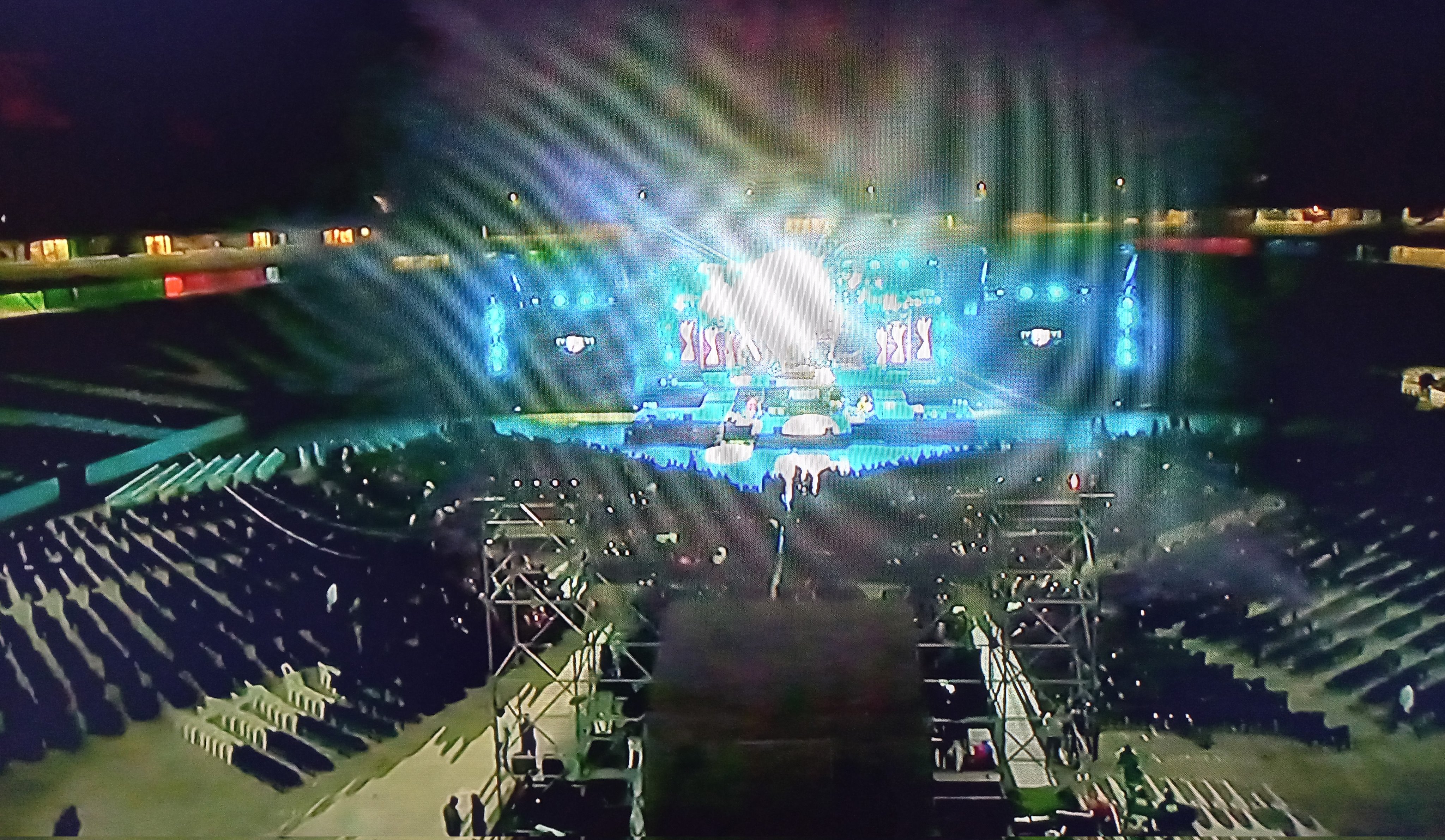
And talking about seating, once again viewers were subjected to a litany of empty seats with no seat fillers.

Rows of empty seats constantly popped on screen since each empty one had a big white A4 page with a seat number printed on it attached to the backrest. 

It sends the message to viewers - rightly or wrongly - that this isn't something worth their own time or worth watching since the people in attendance aren't bothering either.

Those shown seated, are shown looking down and being on their phones. 

Multiple times people are seen just standing around, milling about, or in front of the stage looking like last year's unorganised chaos. Other times, people took too long to get to the stage since they were obviously seated too far away. 

No professional seat-fillers were employed and the cameras constantly showed empty seats.

Multiple politicians and representatives were unnecessarily included as presenters who didn't know how to speak properly on stage within an awards show format and made mistakes - likely due to not having practised speeches or keeping to prepared speeches, making for extremely cringe-embarrassing errors and spouting things like "And the various winners are" instead of saying "nominees" for instance.

Several didn't understand, or didn't adhere to (or maybe wasn't told) the need to stand directly behind, and close to the stage mics when speaking. The result: Many couldn't be heard or were too soft. 

During the In Memoriam segment, shockingly an Assupol logo for funeral cover was plastered over the segment, turning something that should be solemn and professional looking, into a tacky, unprofessional commercial cash grab for attention.

Even after it was over, the unprofessionalism of the 18th Metro FM Music Awards wasn't over.

Adding insult to injury, multiple media complained that they didn't receive the winners list or a basic press release on Saturday night (which is an unnegotiated must from an awards show) from the SABC or an outside PR company which was again contracted this year. 

This was only emailed out on Sunday at 13:00 by Bluecloudai, and only after requested by which time it was too late.

South Africa's music industry, artists, agents and record labels, South Africa's broadcast and film industry, the Mpumalanga provincial government, as well as ordinary viewers subjected to this bad television and forced to sit through sit, all deserve better TV than the failing standard of the SABC's Metro FM Awards.


Thursday, May 11, 2023

TV REVIEW. 2023's returned 17th Metro FM Music Awards was shockingly bad. The bigger question is why - again?


by Thinus Ferreira

After an absence of five years, the Metro FM Music Awards returned on Saturday night to SABC1 - bloated, bad, looking cheap, disorganised, badly attended, and marred by video and sound problems and category hosts and winners who didn't know what to do on stage and how to behave within what's supposed to be a meticulously planned out production process of a live awards show. 

The bigger question is why? And why again?

The televised monstrosity of the 17th Metro FM Music Awards was just as bad as the multiple previous MMAs in previous years I've sat through and watched until the last one in 2017 in Durban.

That was the last Metro FM Music Awards before allegations over corruption, payola, the buying of awards and mismanagement took it away. Then followed Covid. 

Now, back after half a decade, and as if nobody has learnt anything or bothered to go back to the tapes to rewatch and improve, South African viewers were made to suffer through yet another disastrous - or hilariously bad - MMAs.

Already this year in late March South Africa was subjected to the absolutely horrifically done 16th South Africa Sport Awards (SASA) organised and done by the department of sport, arts and culture which took place at the Sun City Superbowl in the North West province. 

Now we had the 17th Metro FM Music Awards from the Mbombela stadium in Mpumalanga which, sad to say, looked amateurish and really awful.

This will soon be followed by MultiChoice Africa's 9th Africa Magic Viewers Choice Awards (AMVCAs) done live from Lagos, Nigeria in just over a week's time - another perennial live awards TV show mess. Then comes the DStv Mzansi Viewers Choice Awards likely again done from Tshwane. 

Later this year the National Film and Video Foundation (NFVF) is getting their turn with the South African Film and Television Awards (SAFTAs) in Johannesburg, which just asked for production companies to tender to produce the televised awards. A poisoned TV chalice if ever there were one! 

All of them, every single time, are filled with jaw-dropping on-air mistakes and all vary between bad to absolutely terrible in terms of on-air quality. America's Oscars and the Emmys these ... spectacles ... are not.

Mishaps which viewers see include a general lack of creativity, the running over time and not finishing when they are supposed to, autocue mistakes, errors with everything from sound to audio and wrong envelopes, playing wrong pre-taped inserts, mixing up winners, mixing up winner announcements, terrible presenters making bloopers from names to struggling to read, and overall low production values.

Last week I spoke to a music star in her late twenties for an interview and one of the questions I asked her was what she would tell her younger self and young people today. She said: "Just know it will get better".

Watching Saturday night's mangled black carpet arrivals special - held in what literally looked like some side back-ally of the Mbombela stadium with just a sliver of a black carpet thrown over very visible grey interlocking pavers and harsh and unflattering lights - the music star's words, ironically, kept milling in my head.

Sadly, the production and airing of South Africa and Africa's live award ceremonies simply don't get better.  But why?

The terrible black carpet was followed by a Metro FM Music Awards live awards show which was supposed to end at 22:00 but overshot by more than an hour just to hand out 18 awards, with SABC1 forced to run an on-air crawl to say that Bundesliga coverage would start at 23:00 (it only really ended at 23:15).

Is the problem with constantly bad live awards shows in South Africa that new, hubris-filled producers and production companies come in every year with no recollection and no history of what's on tape from the past and what went wrong? Do those getting the tender not watch previous broadcasts or talk to those production companies about what failed - and why - instead of trying to reinvent the wheel and to try and prevent a repeat of mistakes?

Is it the organisers and the custodians, from MultiChoice and M-Net to the SABC, who either have no remedial meetings or remedial plans to look at what mistakes occurred and strategies to put in steps to prevent the errors from reoccurring? 

Or are there remedial meetings and actions? But if so, why are these steps to improve not working?

Bad live televised awards shows from South Africa and anywhere in Africa make the industries they are supposedly honouring, and the countries and provinces and places they're done from, look bad and unprofessional. 

It sends a twofold message: This is the best quality we're capable of when it comes to doing a live show, the best we're capable of when doing a live show from here, and this is how much (actually how little!) we really think of these people and the biz we're celebrating with such a bad show.

If you're not able to land the TV plane of a live awards show production in time, if you're unable to make it look smart and professional and "desirable" to be there, if the camerawork is erratic and bad, if there are audio and video and pre-taped playout problems, if the presenters on stage are bad and nervous and not properly prepped, Don't Do It As A Live Broadcast!

The problems and mistakes with the co-produced 17th Metro FM Music Awards done by Bonngoe TV and Dzinge Productions with Pepsi Pokane and Shandukani Nsengani as co-executive producers, started right off the bat.

Why did the did black carpet presenters keep asking guests who they're rooting for? Had they no other questions? 

Get someone to ask your parents at a family gathering who's their favourite child and see what happens. People can't say who their favourite is because they work with, or might work with everyone and don't want to damage current of future relationships. Are unprepped presenters so obtuse? 

What else is in the kitty for carpet arrival banter besides the lame and Americanised "Who you wearing?" Do some research and find interesting and better questions to make small talk.


During the live broadcast, SABC1 viewers at home saw block upon block of empty seats right in front of and to the side of the main stage as cameras panned.

Multiple rows of empty seats were scattered right where the VIPs are presumably supposed to sit. Is the Metro FM Music Awards producers too cheap or unknowledgeable about the practice of seat-fillers?

The message it sends to the person at home is: The so-called "important" people - the industry movers and shakers aren't interested to be there - I'm not missing out and this isn't a must-see event. You can "safely" rather watch something else.

Guests supposed to be sitting and watching attentively were literally on their phones, standing around and talking during the awards show. The unintended message: What's happening on stage must not be interesting. 

Multiple winners and presenters on stage turned their backs to the front of the stage (and by implication to the camera and on viewers). The overall result was that the 17th Metro FM Music Awards was not enjoyable to watch - lacking flow, tempo, prestige and quality.

Potential winners have clearly not been prepped to get to the stage as fast as possible and to immediately start talking and to keep acceptance speeches short. There were long silences between segments and category wins with no sound or background music. 

The lighting was bad on stage and inside the stadium. 

Sound errors were numerous when on-stage presenters spoke but couldn't be heard since their mic channels on the sound desk were either on mute or the slider too low and equalised too late. Final output errors like a random "30" appearing as overlay over presenters' faces were laughably bad. Performers, category presenters and winners screamed into mics, causing sound distortion. 

The list of mistakes goes on and on.

It's superfluous to repeat the age-old adage of those who refuse to learn from the past are doomed to repeat it. 

Just back after a five year break, the Metro FM Music Awards is yet another very visible and telltale sign that South Africa's live awards ceremony show-and-tell way of doing things is and remains broken. 

Somehow, we refuse to learn from the mistakes from the past, refuse to improve and refuse to try and do better when it comes to live awards shows. And why it won't be getting better.

Thursday, December 23, 2021

SA TV 2021: A shockwave year in television filled with loss, lockdown and an octopus that won an Oscar.


by Thinus Ferreira

During South African television's tumultuous 2021 - bearing witness to shocking unrest and looting, neverending loadshedding and an unfolding Covid-crisis - the one reassuring constant was TV soaps and telenovelas like Uzalo, with the nation's nightly collection of comforting primetime series stretching from Generations to Isono that continued to provide a sense of uninterrupted assurance and "normalcy" in a world seemingly gone mad.

In probably the worst year on record for South Africa's TV and film industry - rocked by a shockwave of thousands of permanent and temporary job losses as work evaporated, hundreds of deaths due to Covid-19, as well as countless and repeated Covid-19 production shutdowns across multiple series under Lockdown Level 4 - 2021's big unrecognised TV miracle is that the TV soap operas endured.

As the industry was upended behind-the-scenes, TV channels kept broadcasting new episodes nightly during 2021 with its escapist local mix of fantasy, conflict, weddings and scandals, that continued to enthral a combined audience of millions of viewers across Southern Africa.

In 2021, South Africans watched Squid Game on Netflix, Devilsdorp on Showmax and welcomed House of Zwide on e.tv. 

Viewers sat transfixed before eNCA, Newzroom Africa and SABC News to see former president Jacob Zuma being arrested and going to jail, and how South Africans ransacked shopping malls. 

They huddled together in front of the soft glow of their TV screens when president Cyril Ramaphosa beckoned for yet another "family meeting".

Love Island South Africa on M-Net flopped but The Bachelorette SA was more successful. The Real Housewives of Durban and Survivor South Africa: Immunity Island (forced to film in South Africa on the Eastern Cape coast) were hits. 

South Africans got their Friday episode of 7de Laan on SABC2 back (that also reached 5000 episodes). 

While kykNET's new on-air rebranding was more successful, SABC3's rebranding to "S3" saw the channel's already anaemic ratings only fall further this year while its Isidingo replacement, The Estate, failed in luring the viewers it should and likely on borrowed time

uBettina Wethu (South Africa's Ugly Betty-version) wasn't the success it could have been. Showmax tried Temptation Island SA as both it and Netflix added further local South African content to their catalogues.

MultiChoice's Showmax launched its first South African telenovela, The Wife, but the most expensive South African drama series yet produced, Blood Psalms, missed its October debut and was pushed to February 2022 because the department of trade, industry and competition failed to pay the millions due to the show in the country's broken film rebate scheme.

MultiChoice introduced DStv subscribers to Korean telenovelas ("K-drama") with tvN, kept losing DStv Premium subscribers, while M-Net brought pay-TV subscribers Harry and Meghan sit-down talk with Oprah.

The SABC that turned 85 completed its retrenchment plan getting rid of hundreds of workers after which the public broadcaster once again became embroiled in serious allegations of SABC News editorial interference

In 2021 fewer people than ever (down to 21% bothered to still pay a SABC TV Licence with plans to scrap it altogether and replace it with a new type of tax.

The SABC officially launched SABC Sport as a TV channel, while SuperSport did its best to try and bring live sports back this year and branched out into more school sports coverage.

Britbox SA and eMedia's eVOD both launched as two new video streaming services in South Africa in 2021 while ViacomCBS Networks Africa abruptly cancelled its MTV Africa Music Awards it tried to revive this year. 

The M-Net City channel changed to Me, Glow TV was removed from Openview but had to be returned after a court case, and StarSat shed more TV channels this year. 

The long-delayed completion of the switch from analogue to digital terrestrial television (DTT) broadcasting in South Africa was yet again postponed, with new warnings that suddenly switching off TV signals to millions of viewers who don't have set-top boxes to receive the new signals, will damage South Africa's TV ratings system.

Meanwhile worsening Eskom blackouts continued to have a debilitating impact during 2021 on TV ratings, damaging all broadcasters and advertisers with loadshedding that wiped millions of TV households from the national viewership data.

Moja Love (DStv 157) - which had to suspend Jub Jub on Uyajola 9/9 as its most-watched show after rape allegations - and Mzansi Magic (DStv 161) were the two most-watched pay-TV channels in South Africa in 2021. 

SABC1 remained the most-watched free-to-air TV channel. More South African TV news reporters were attacked and robbed this year than ever before.

South African viewers lost FOX after 11 years, The Bold and the Beautiful (again) and weather presenters on eNCA and eNuus. The ratings for the 17th season of Idols on Mzansi Magic plunged as Somizi Mhlongo exited as a judge after serious allegations of physical abuse.

We lost Africa's most influential woman in television, MultiChoice's content boss Aletta Alberts, to Covid, as well as producer-actor Shona Ferguson in July, and an unending TV treasure chest list of names gone too soon who have enriched and who were deeply woven into the tapestry of South Africa's TV industry. 

We lost icons from Franz Marx to Shaleen Surtie-Richards, with calls that more must be done to support and protect South African artists and performers while the South African government for another year refused to make the Performers' Protection Amendment Bill (PPAB) a law that would ensure that actors are paid residuals for TV rebroadcasts.

We said goodbye to LIVE AMP on SABC1 after 25 seasons, as well as the beloved TV news anchor Noxolo Grootboom who read her final TV news bulletin with even Cyril Ramaphosa moving his national address out of the way so that the nation could watch her swansong first. 


South Africa's TV and film industry and film lost at least 18 669 jobs (59%) over the past year due to Covid. 

And in-between the tumult, a little film on TV about a friendly South African octopus won an Oscar.

Tuesday, May 21, 2019

TV REVIEW. Why the meltdown ending of Game of Thrones robbed viewers of their Snow.


Most big stars eventually burn out and collapse under their own sheer weight. That’s also been the case with the final episode – and in fact the whole 8th and last season – of HBO's Game of Thrones that ended in an unfortunate meltdown and became a victim of both its own success and viewer expectation that it simply couldn't sustain for a fitting finale.

Like Seinfeld, Lost and Little House on the Prairie (that literally in the end blew everything up), David Benioff and D.B. Weiss decided to burn everything down – with the help of a dragon – in a disappointing viewer expectation scorched earth approach; leaving viewers who had invested their time, money and effort for close to a decade in a story, with few satisfying answers.

Even worse, the final season and final episode of Game of Thrones provided few answers that "made sense" given earlier character motivations and plot development. 

It even failed to make good on the original, central premise: Who will get to sit on the Iron Throne? (Spoiler alert: No-one, but in another unearned twist not because there were not any Westeros candidates left.)

Game of Thrones is a great TV show marred by a bad final 6-episode season and an unsatisfying conclusion – like going to a restaurant, ordering chocolate cake because it's on the menu and the waiter returning to tell you it's not available. The ending damages the build-up and viewing journey that came before it.

The slow derailment of George R.R. Martin's TV adaptation that became evident around the 6th and 7th seasons and became very clear during the 8th season where almost every episode was worse than the one before it, will impact the show's standing and legacy as a truly great TV show.

Knowing that Game of Thrones ends in a way in which it kept moving further and further away from what it once did best, will have a very negative impact its rewatch value under fans and consumers of the story, its binge-watching potential and the sale of solid-media like DVDs and BluRay discs. Less people will want to collect and keep it.

The final episode and the final season of Game of Thrones will definitely rank among the least satisfying series conclusion and endings of all time. 

Viewers are left wanting "better" for the characters – not better circumstances for them but a better motivation, setup and plot, and explanations for why and how they all ended up where and how they did.

If there isn't logic and sticking to the in-universe rules for characters, coupled with a roll-back of character development and a sudden lack of agency for several main characters as what Game of Thrones did in its final season and episode, there can't be an acceptable and logical conclusion in the end.

Watch Game of Thrones if you've never had before or the final season and ending, but be warned and know that it doesn't just run out creatively but that it eventually collapse in on itself entirely – creatively and production-wise.

Mistakes like a modern-day coffee cup and a plastic water bottle in episodes' scenes and the too dark battle of Winterfell that neither the producers and directors during filming noticed, not the editing booth or anyone else in post-production, the abrupt and unmotivated character changes, and multiple unexplained things like The Wall suddenly being whole again, are all symbolic of how almost everyone involved with Game of Thrones' final season just checked out from caring to make the show make sense.

Probably more concerned about the next job and whether there's a gig at America's Got Talent or wherever, the loser is the viewer who gets short-changed with an ending that needed more care and more episodes. 

The ending of Game of Thrones suffers from a lack of proper narrative structure, a forced plot and a forced end-point that in turn forces characters to suddenly change. It leaves too many gaps and unanswered questions.

Multiple, multiple scenes, story-arcs, plot points and story and character development have been set-up since the first season and continue to wind throughout the various seasons, to which there are no pay-offs in the final season and the final episode. It leaves viewers empty and wondering: What was the point? 

The characters and story of the Game of Thrones TV version will always remain beloved and have made a permanent, global pop culture imprint, South Africa and Africa included. 

We will continue to love to love them ("You know nothing Jon Snow") and continue to love to hate them (oh, Cersei!), despite the Lord of the Rings-esque ending as they literally sail and walk off into the sunset and the snow.

The end of a TV show doesn't need to answer or pay off everything but Game of Thrones is not as good as it could have been because it provides less, and less fitting, answers that what a sprawling fantasy magnum opus like this should.

We've lived with these people. Parts of us died when they (and some dragons) died. We've journeyed with them and the Dothraki to strange new worlds and lands and watched them not just fight against a collective foe but battle each other. 

For years we patiently waited for winter to come. Yet, in the end, we can't help but be disappointed when we finally got to see what happened with, and had to say goodbye, to the Snow.


Episodes of Game of Thrones broadcast on M-Net (DStv 101) are currently available on DStv Now and Showmax, and will be followed by the broadcast of a 2-part “Making of” documentary showing what happened behind-the-scenes.

Monday, April 15, 2019

TV REVIEW. The Game of Thrones season 8 premiere signals that this Neverending Story will have an end.


The following review contains a few unavoidable spoilers regarding the Game of Thrones season 8 premiere.

At Monday morning's Nu Metro big-screen cinema screening in Cape Town at 03:00 of the premiere episode of the 8th and final season of HBO's Game of Thrones on M-Net (DStv 101) someone won a set of GoT dinner plates - perfect for the season's first episode that didn't, and couldn't, feature a lot of action as the fantasy series had to start to (re)set the table to tell the last part of the story.

After an absence of 20 months, viewers are getting their first new Game of Thrones episode and it didn't disappoint although it might feel slightly "average" compared to what came before.

It's necessary since characters need to be reintroduced to the audience and each other and literally moved to new places on the sprawling Westeros map - as illustrated by the magnificently updated and changed Game of Thrones opening sequence that looks terrific.

The season 8 premiere episode starts off formally with an army marching into a new home at Winterfell, has a cutesy - maybe too-cutesy? - Neverending Story-like dragonriders sequence in the middle, and then a horrific and scary part at the end just to remind viewers what they're actually watching and that is foreshadowing the brutal clash that is surely coming between Westeros' humans and the undead White Walkers led by the Night King.

The first episode can definitely be classified as a reunion and includes some must-do visual and verbal exposition from dungeons to dragons and Jon Snow (Kit Harington) being told about his true parentage. Viewers see several old friends, frenemies, family members, family frenemies and foes meet up, reunite with some actual time for discourse and discord.

Thought things would be fine and stay fine between Jon and Daenerys Targaryen (Emilia Clarke)? Sorry but this ain't that kind of fantasy story. Thought things would be fine between brother Jon and sisters Arya (Maisie Williams) and Sansa (Sophie Turner)? Clearly it won't be.

And in the final moments of the season premiere, a deliciously ominous "reunion" between Jaime Lannister (Nikolaj Coster-Waldau) and Bran Stark (Isaac Hempstead Wright) who he tried to kill years before, shows how the opener is setting up physical showdowns between enemy and enemy, in various forms, who are all finally going to come face-to-face with each other.

Dragon-parts, done well. Some dry humour parts, done well ("Poor girl, the pox will take her within the year"). A spider-like, spiral-mural horror-scene, done extremely well.

There are not really grand visual statements, massive surprises, gory ends to main characters but as the knives, forks and dragon glass forged weapons are being laid out, you know they're coming as surely as the undead army is advancing from beyond the now broken wall.

"Nothing lasts," declares the character of Varys in the episode - signalling that this fantasy Neverending Story does and will have an end and that viewers better enjoy the last of the quieter times before the final chapters featuring all-out battle sequences and with it the horrific devastation that is looming.


ALSO READ: 'I took Game of Thrones leave': South Africans stay awake to watch the 8th season premiere of Game of Thrones on M-Net at 3am at Nu Metro cinemas as show's conclusion is set to shatter rating records.
ALSO READ: TV CRITIC's NOTEBOOK. The execution of M-Net, Nu Metro and Johnnie Walker's cinema screening of HBO's Game of Thrones season 8 premiere was tardy, messy, off-brand and lacking attention to detail for each of their brands in a big way. How disappointing.
ALSO READ: MultiChoice and M-Net dropped DStv subscribers in South Africa and across Africa in the cold when its untrustworthy DStv Now app again crashed with technical issues, as its pay-TV customers tried to watch the start of the 8th season of HBO's Game of Thrones.

Sunday, March 10, 2019

TV REVIEW. MultiChoice's Trippin' with Skumba on Showmax is a cheap shot embarrassing production, reeks of inexperience and is an insult to viewers who have to pay to see a st(r)eaming mess.


It's really a problem for South Africa's TV industry that MultiChoice, Showmax and Skhumba Hlophe would put out low-class, badly-produced, cheap rubbish like Trippin' with Skhumba and think that this rough - looking like it was filmed with a smartphone camera - content is fine to be placed on a service asking viewers and subscribers to pay to see it.

It's insulting.

Why was Trippin' with Skumba as a so-called "travel-comedy" commissioned? Who exactly at MultiChoice and at Showmax saw this, okayed the end-result, and signed off on this TV-trash as being content that fits a presumably premium brand like Showmax, and the brand values and perceptions attached to a video-on-demand streaming service?

Trippin' with Skhumba as a "Showmax Original" that is a rip-off from Jerry Seinfeld's Comedians in Cars Getting Coffee looks like something that SowetoTV as a community TV channel or SABC1 would have done, made as a roughly cobbled together collection of video clips someone's cousin recorded over Christmas on his Samsung phone and who knows how to hold a phone up and press "record" and "stop".

It defies understanding and belief how Yolisa Phahle, MultiChoice CEO for general entertainment, as well as both Niclas Ekdahl, CEO of MultiChoice's Connected Video unit and Candice Fangueiro, head of content for MultiChoice Connected Video division, could honestly put a TV show like this out to market.

Niclas Ekdahl and Candice Fangueiro both placed their names as executive producers on Trippin' with Skhumba, so surely both are aware of it, how bad it is, and the damage that trash television like this does to something like Showmax that they presumably are trying to establish and grow instead of deliberately damage.

Is Trippin' with Skhumba on brand? It's off-the-road st(r)eaming trash.

"Racism" might be a word too far, but why does watching Trippin' with Skhumba as Showmax's first "vernacular original series", clearly targeting a black audience, leave you thinking that somehow MultiChoice and Showmax thought it's "okay" to produce low-class content because it is in vernacular language involving a comedian going to back-valley places?

Showmax is tripping if it think this is fine because this is not okay.

I feel really bad for Skhumba Hlophe. Why was his show not given enough money and proper resources, with sufficient and experienced production know-how, to create a show with adequate production values that fits his brand and that fits with what Showmax markets itself as being?

Something can be done cheaply on a shoe-string budget, something can be done small, something can be done quickly and it can still be good. Why is Trippin' with Shumba vlog-like trash?

M-Net (DStv 101) would never broadcast or put something on like this, and it recently did a local travel show, Wingin' It. So why is Showmax?

Is this Showmax's version of something half-baked if it catered to a Mzansi Wethu (DStv 163) audience? Very bad.

The basics - irrespective of whether something has a big or small production budget - should be done right. In a stage performance, the curtains should open and close. Actors should know their lines whether the script is good or bad irrespective of whether the community theatre or Broadway play is great or terrible.

Trippin' with Skumba is an awkward mess except for the establishing drone shots (the quality of which is so much better, which in itself doesn't fit with the rest, creating another problem. But let's leave that there.)

It's insulting and condescending to the audience to imagine that this is what potential viewers of this show should expect and be satisfied with. The show makes it clear that Showmax doesn't think that the target audience knows better or that they apparently deserve better.

Skhumba Hlophe is a bad interviewer/TV presenter and struggles with proper eye contact with people he's talking to.

To add to this problem it doesn't seem as if a producer beforehand went over a list of open-ended questions with him that he should or could try and ask of guests.

Too much in terms of pre-production was seemingly just left to "let's get in and go". Besides going to a physical place in each episode, where do episodes go? What is the point? What does an episode leave the viewers with to proverbially "take home" in return for their time and for paying to watch it?

Hanging out with local comedians where they grew up, should visually and metaphorically open up and expand on them and the area - not keep viewers guessing, and keeping them guessing with erratic and cropped shots.

Instead, everything and everyone in Trippin' with Skhumba remains firmly boxed in with director Vincent Moloi.

Why the shaky camerawork? Why the boom in frames? Why is almost everything filmed as close-ups? Why does music just start and suddenly stop and then new music start again?

Trippin' with Shumba feels like a film school's first take handed in for a second term assignment. The desire to do video content is there but not the experience or skill. Nobody on-camera or behind the camera seems to have enough experience making TV. Yet this pointless travelogue mess is dished up for viewers on a pay-service, where subscribers are asked to pay for substandard content.

Tripping' with Skumba fails to leave the viewer - who, again has to pay to watch this - not enriched as to the actual places and people visited and spoken with. Why make the effort for superficial chit-chat?

It's not even a travel show, but just compare how magician Drummond Money-Coutts talks and interacts with small-town South Africans in the dusty streets of a backwater town in the South African filmed episode of Death by Magic and how residents are portrayed and brought to life in that episode, in contrast with how the residents are filmed in the dusty streets  in small-town Trippin' with Skhumba.

Trippin' with Skhumba isn't and shouldn't be Top Billing, but what that show masters in terms of production basics with inserts, is to showcase a place and people being interviewed properly.

Those basic tenets of profile-piece television can be properly accomplished in a high-end show, or even a low-budget show like Khumbul'ekhaya, which means Trippin' with Skumba doesn't know or doesn't care to know how to get the basics right.

Showmax shouldn't do "local content" if the output is of this standard. It drags itself and the reputation of South African television production down.

Friday, November 16, 2018

TV REVIEW. Dynasties on BBC Earth with Sir David Attenborough is agonising, haunting - and painfully beautiful.


Of course, as basically a given, the arrestingly beautiful, masterful new animal series with Sir David Attenborough as narrator starting on Sunday on BBC Earth (DStv 184) at 16:00 will get a score of 5 out of 5 - but here is why you should watch although, yes, it will make you cry: The animals featured in this painfully-beautiful new series needs you to experience their personal struggle for their place in the world.

The sumptuous, poignant and meticulously filmed 5-episode Dynasties is yet another wildlife filmmaking television piece of art from the BBC Studios Natural History unit, this time following 5 animals - a chimpanzee, penguin, lion, painted wolf and a tiger as they struggle to not just defend their place in the world but in what has become man's world.

With a focus on families, an hour of Dynasties flies by with an immersive filmmatic experience and totally engrossing narrative into the animals' epic, daily struggle for survival, captured over hundreds of days and distilled into awe-inspiring stories of an hour each guaranteed to leave you as viewer emotional and moved.


With unexpected - often honestly shocking moments - narrated by Sir David's trusted, tempered and understated tone, beautiful and often heartbreakingly beautiful moments from nature flashes by, detonating emotionally compelling bombs you can't bear to watch, and yet simply can't look away from.

Sunday's first episode covering a troop of chimpanzees in south-east Senegal in West Africa quickly gives the viewer a very clear indication of what's in store in Dynasties: Without the need to antropomorphise, the viewer - consciously or unconsciously - gets a guttural and visceral assault on the senses. You understand what you see as a relatable struggle that humans can identify with.

More than just struggling to live and to stay alive, these animals' survival are intimately and intricately linked to others like them, but also to the (rapidly shrinking) physical space they inhabit and their place in the "hierarchy" within that space.

Unscripted, undiluted animal-world Greek tragedy plays out in Dynasties and just as unpredictable as nature is, so unpredictable is how episodes of the series unfolds. 

As the TV pendulum in Dynasties swings and alternates between heartbreaking and happy moments, the viewer gets a true sense of the never-ending power struggle these iconic animals are tied to every single waking moment of their lives, captured over the course of four years.

Just like the animals, while watching Dynasties, viewers don't dare let their guard down.

It's agonising. It's haunting. It's painfully beautiful. Which is precisely why Dynasties is absolutely must-watch television.


ALSO READ: 5 animals fight for survival in BBC Studios' 'cinematic, unpredictable and compelling' new natural history series Dynasties starting Sunday on BBC Earth.
ALSO READ: IN PHOTOS. The South African media launch of BBC Studios' amazing new natural history animal series, Dynasties, and IMAX press screening.
ALSO READ: 'Sir David Attenborough said he though we were mad': Here are 5 things about BBC Studios' beautiful new natural history series, Dynasties, you want to know. 
ALSO READ: INTERVIEW. 'We had an idea of what might happen. What actually did happen ... ' Rose Thomas, producer and director of the Dynasties chimpanzee episode, talks about her experience making the new BBC Studios 'Game of Thrones'-like natural history series. 
ALSO READ: The producer answers your burning questions about what you saw in in the first episode of BBC Earth’s Dynasties, and what happened to David the chimpanzee.

Friday, September 21, 2018

REVIEW. The first Comic Con Africa 2018 at Kyalami was super enough - but there's a lot of room for improvement.


While Aquaman waited to gain entry, the cosplay visitor before him held out his VIP ticket and a plastic grey gun as the security guard told him that "You're not allowed to bring a gun in".

The muscular superhero who held a (plastic) sword in his other hand, didn't know whether to laugh or what to say. Meanwhile off to the side, the Angel of Death - in sprawling black feather wings adorned with multiple amber eyes - was temporarily denied entry at the gate. If she wasn't going to be let in, there was sure going to be hell to pay.

The inaugural Comic Con Africa 2018 - South Africa and Africa's first - that took place this past Friday to Sunday at the Kyalami race track in Johannesburg was super enough and buzzed with colour, krypton and excitement but there's a lot of room for improvement that Reed Exhibitions need to look at. 

Firstly, the Kyalami Convention Centre is not the best venue for something like this because of the crowds and (hopefully in future more panel discussions) but also due to layout, which ties in with the second problem - the parking, parking logistics and the walking distances.

Comic Con Africa will work better in a bigger, more "blocky", more self-contained venue where people are able to get much closer to the actual gates and doors without having to walk kilometres in costumes and carrying heavy hard drives, computer processors and kids. Even the Harry Potters from House Hufflepuff arrived by leg with broomstick in hand.

The lack of adequate signage, both outside (especially outside) and inside Comic Con Africa 2018 needs to be improved.

For an hour and 15 minutes I stood at the exhibitor/VIP entrance at Comic Con Africa 2018, just observing, as hundreds of people arrived after already having walked very far, only to be told (and not told!) that they need to walk down, and then up to the general entrance gate - with no signs, no directions and no help.

I lost count of the number of "F"-words uttered, visitors remarking on the confusion, and fatigued people who just arrived, egamers carrying heavy computer boxes and families with little kids who were already in a bad mood after they popped out after walking over the bridge and disappointed at the long further walk to get in.

How about loop-run golf carts to help people (and their costumes) to get between the entrance/exit gates and their cars? Luckily it didn't rain, but how are people in costumes and with electronics like computers they must carry, supposed to get inside the building without getting wet?


R50 for a slice of pizza? The exploitation from the very first Comic Con Africa in terms of food price gouging need to stop. If this is sold as a family event, make prices for food affordable for families who visit and who are forced to buy it there.

Guides and helpers inside Comic Con Africa 2018 very not just good but actually very good. Everyone interacted with, and everyone of them observed as they helped people asking things (directions and times for events/panels/activations topped the list) were really helpful, informed, knew what to say - and were extremely, and surprisingly, friendly.

With the horde of people besieging them, you'd think they'd appear overwhelmed or stressed, but all of them were helpful and professional - as were the first aid medical team who were quick to help people with things like when a child swallowed a bee inside a Coca-Cola can.

The cancellation from the few overseas stars promised to attend, right up until the day before was a disappointment and a no-no.

Also most of them were "past prime"instead of Optimus Prime. Having someone like Travis Fimmel from Vikings at Comic Con Africa 2018 doesn't really serve a purpose if the character Ragnar already died almost two years ago. The actor has little to contribute to or tease about the future or progression of the character - which is what visitors, the media and pop culture aficionado's are interested in.

Which bring up the next point. Hopefully Comic Con Africa 2019 will attract better and more high-profile overseas TV stars in science fiction and fantasy who have current zeitgeist currency, as well as high-profile local stars.

More should also be done to add actual real panel discussions. Viacom Africa did a Moosebox and women in animation panels, while Showmax, M-Net Movies, M-Net City, Netflix and SundanceTV with a fear tunnel with (why are they smiling instead of looking scary?) zombies, all did interactive "activations".

What Comic Con Africa visitors are looking for who ended up taking photos posing next to life-size statues of Batman and jumping on a Netflix SA Disenchantment inflatable castle, are real-life stars they know and love and people appearing and talking about their shows and projects.


There should be bigger interaction between Reed Exhibitions on the one hand, and MultiChoice, M-Net, Showmax, Netflix South Africa, Amazon Prime Video and film distributors on the other to actually get stars, and have interesting panels and Q&A sessions about the shows and their projects. This will still hopefully happen as Comic Con Africa develops.

Lastly the PR aspect needs a lot of improvement. Where were the flurry of invitations to the press beforehand to cover specific aspects of Comic Con Africa 2018, the interactive media liaising during, and the reams of press releases about aspects of the event and what came out of the few panels that did take place?

How many media knew that Viacom Africa is launching its Moosebox animated series at Comic Con Africa, or that M-Net Movies is doing a DC Heroes pop-up channel on MultiChoice's DStv in November and "activating" it with an escape room at the event?

Future Comic Con Africas need to be made more accessible, with more communication, and filled with more relevant topline talent.

Reed Exhibitions and the organisers really have to "pre-walk" the planned event around the block - literally - from the neverending entrance traffic jam to the toilets, the food stands, seating and crowd flow, to see how ordinary visitors - not exhibitors, media or VIP guests - are really having to navigate the event, to improve aspects of it.

Wednesday, December 16, 2015

REVIEW: Star Wars The Force Awakens brilliantly reshapes George Lucas' modern myth in the story that continues to try and bridge the gap between fathers and their children.


(This review written by a critic that's been a longtime Star Wars fan and contains no spoilers.)


What is it with every generation of fathers? 

Luke Skywalker has disappeared, but moviegoers can gladly put in an appearance at the cinema for two hours and 16 minutes to see Star Wars: The Force Awakens – a visceral, moving tour de Force that’s definitively the best in the entire saga after The Empire Strikes Back and A New Hope.

As for Luke, don't worry - he shows up. Eventually.

Anyone in love with George Lucas' sprawling galaxy far, far away and even newcomers or those less familiar with the Force will find a visual delight and their emotions tested in the dark side of the cinema in the next, very well executed chapter of the franchise taken over by director JJ Abrams.

To those who fell in love when Luke Skywalker first started at the horizon where twin suns were setting to a rousing score, feel that The Empire Strikes Back is the best in the series and for those who abhor the sequel-prequel trilogy – The Force Awakens is definitely the movie and further continuation of Star Wars you've been looking for.

As Episode VII, Star Wars: The Force Awakens is an emotional unveiling of a next chapter in a story that solidly remains at heart a tale about trying to close the gap, and bridging the distance – literally and figuratively – between fathers and their children.

As if it hadn’t become transparent over the past three decades, Star Wars latest iteration as a modern myth makes it abundantly clear that it’s become the most classic cinematic Bildungroman of all: Star Wars The Force Awakens again restarts the youth’s search for meaning, purpose, and parentage – and this time it’s also the inverse: the parent’s search for child.

The Force Awakens is a visually authentic, nostalgically sound and forward-Force-facing addition to the Star Wars universe – an Oedipus opus that’s the new first act of a new saga, referencing back but laying the solid groundwork for new characters, character development, plot points and yes, a spectacular new war amidst the stars.


History repeats itself but this time in an opposite way. Absent fathers and father figures still fail their children (sons and daughters), but children also fail (and save!) their parents in the film that feels expansive and harkens back to the timeless and massive size and scope of the original Star Wars trilogy.

With a lot of death, destruction, deterioration and some big shockers – there’s at least one climactic, tragic scene between a father and son that rivals and deftly mirror’s the now iconic ‘Luke, I am your father” – the movie is definitely not meant to be seen by anyone under 12.

While previously Star Wars spurred endless debate like "Did Han shoot first?", The Force Awakens will have moviegoers long be talking and definitely debating things like seeing Han Solo again and the new Death Star.

Some dramatic plot points are foreshadowed and can be guessed and figured out fairly quickly within half an hour by real Star Wars fans due to framing and exposition limiting some of the surprise but it doesn’t in any way take away or diminish from the sheer enjoyment and emotional gut punches that’s delivered when ancestry is revealed and when a major death changes the ongoing expanding Star Wars universe forever.

Right up to the end – and literally in the final scene – The Force Awakens continues to be the unfolding of a new journey and to be the passing of the baton to a new Star Wars generation.


A beautiful inverse
While the new film is a new start – an expansion of the established mythos – it incorporates the cleverest of of Jedi minds tricks: a fully and very calculated, inverted story.

Beneath the surface basically every single thing is not just symbolic but also the beautiful inverse of what Star Wars fans saw previously – from camera angles, characters, scenes and a lot of dialogue.

To appreciate the magnitude of some of the moments and events happening you really do need to see A New Hope, Empire and Return of the Jedi first to fully revel in what JJ Abrams and Disney taking over Lucasfilm have very successfully been able to accomplish.

Yet even for casual moviegoers not steeped in Jedi tradition or Wookiee lore this “space movie” will be an enjoyable holiday film fantasy romp through the stars.

While The Force Awakens is filled with dense narrative techniques and very clever mirroring of the work that came before it that can keep film critics and academics busy disecting it for weeks, it’s not flawless but won’t matter if enjoyed on a purely superficial level – as million of people around the world surely will.

The acting Force is definitely with the new stars. You easily lose yourself in the standout and emotive portrayal of Daisy Ridley as Rey. John Boyega as Finn and then the antropomorphic droid, BB-8, are wonderful and dear old Chewie – still actually young for a Wookie – will have you laughing out loud together with moviegoers.

The somewhat disappointing Adam Driver as the new dark nemesis Kylo Ren is however no Darth Vader (one character somewhat ironically remarks that “Your biggest fear is that you will never be Darth Vader”) and will possibly develop as the trilogy rolls out.

Star Wars will still be and is the definitive movie series dads take their sons to. Now they – and mothers – can take their daughters too.