Wednesday, March 2, 2022

MasterChef SA S4 Day 2: Out for a duck.


by Thinus Ferreira

In the second episode of the 4th season of MasterChef SA on M-Net (DStv 101) it was instantly clear that MasterChef SA judge Gregory Czarnecki's duck dish would be the most difficult to get right out of the three judges' dishes - which led to contestant Mohammed getting axed.

In Tuesday evening's episode, the contestants were divided up between the three judges and had to prepare one of their dishes that revealed a bit about themselves, with judge Zola Nene that said they were looking forward "to tasting my memories through your cooking".

There was Gregory Czarnecki's "duck a la Orange" - a simple yet very difficult recipe to execute with the secret in the sauce - with duck fat confit potatoes and sultana pancakes.

Zola Nene's "isinkwa sombilla" had steamed mielie bread, cheese sausage and apple chutney that was made by her maternal grandmother.

Judge Justine Drake's dish was an Asian noodle broth of ramen, fragrant meat and vegetables.


Several of the contestants mentioned to the judges that they felt like failures when it came time to bring their dish to the judges' table.

Tasnim came close to tears, telling them that "It fell apart. It's really not what I wanted to put in front of you, I mean no disrespect."

She made Justine's noodle dish - and what a surprise: She got one of the highest scores and had nothing to be worried about.

Mohammed said "I feel angry and I feel embarrassed and I feel ashamed to bring something like this forward".


In the end Onezwa, Masedi and Mohammed rounded out the bottom three, with Mohammed who got sent home after Gregory said that his duck dish "didn't bring the emotion that I was looking for".


First time cooking duck
"Following on from the introductory episode and the challenge of preparing a starter, Tuesday's second episode is where the judges were introduced to DStv subscribers and the contestants," says content producer Errieda du Toit.

"Each of the three judges presented a definitive dish that says something about them. The contestants had to draw a card to see which dish they had to prepare, and they had to replicate it exactly."

"For most of them it was the first time eating duck, cooking duck - the daylights frightened out of them having to make duck a la Orange."


Tuesday, March 1, 2022

MasterChef SA S4 Day 1: Spilling the tea inside the MasterChef cathedral.


by Thinus Ferreira 

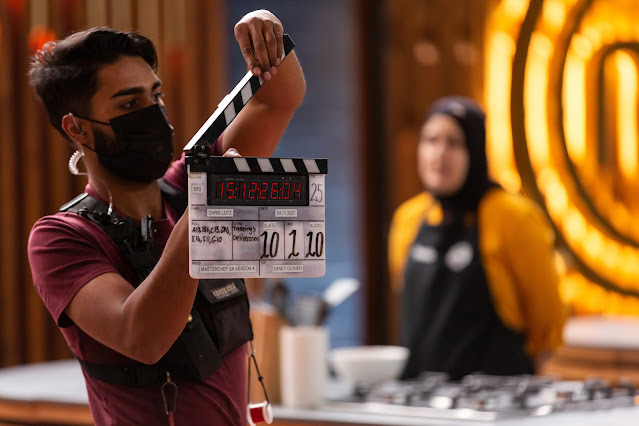
On Monday evening the new collection of contestants in the 4th season of MasterChef South Africa on M-Net (DStv 101) made an atrium entrance just like Donald and Melania did in 2015 - but this setting is Makers Landing inside a "MasterChef cathedral" with the goal to be crowned South Africa's masterchef of 2022. 

By the end of the episode, viewers saw an emotional judge Justine Drake almost starting to cry, more than one contestant sent home at the end of the first episode already, beautiful food art, contestants already crying real tears during emotional moments, and a very cute and desirable Pick n Pay pop-up pantry where you get to pick without having to pay.


The first episode - as do all reality shows - started peeling back the backstories of the varied contestants - done beautifully with slow-motion scenes, mood-setting music and lighting, as well as emo-quotes that instantly endear and humanise them as competitors to MasterChef SA viewers.


Of course the first episode of a MasterChef SA season started with the challenge of a starter - but this one was mixed up in, and mixed in, a lot of emotion. The must-use ingredient was something truly homegrown, South African: rooibos tea.

"I refer to it as the 'blood against the wall episode," says content producer Errieda du Toit. "It was traumatic for them but that is about the start and about having this chance to good first impression."


Masterchef SA casting and cathedral
About the setting of Makers Landing, Homebrew Films producer Paul Venter says "Makers Landing was designed for this".

"We already had the electricity on the floor - all the plugs were there. The set design is part of the MasterChef Bible, the units are modular and you can build your own kitchen how you want it, there are loose gas bottles inside them, the water system is built-in so you don't have to do any plumbing".


Homebrew Films producer Jaco Loubser says "Makers Landing was perfectly suited for what we needed to do here because a lot of the back-kitchen stuff that we would need to build in other settings was already here. Ninety percent of what we needed was already here".

Paul says when Banijay executives visited the set they said it felt to them as if they're stepping into "a MasterChef cathedral". 

"It's got this height and wow-factor, and space. It's much bigger than MasterChef Australia, so of course the 4th season of MasterChef SA is going to be fantastic in this setting of Cape Town's V&A Waterfront which just elevates everything further."

About the diversity of the MasterChef SA contestant this season, he says "it completely worked out like this naturally".

"We did not have a quota system, we didn't manipulate anything; it was actually the most amazing experience for us to literally see it work out the way that it did - the representation, the demographics - it just worked out amazingly well".

Season 8 of Uzalo introduces new ensemble cast to the KwaMasha drama led by the ruthless matriarch of the Magwaza family.


by Thinus Ferreira

The 8th season of the most-watched show on South African television will debut on Friday 4 March when Uzalo on SABC1 will introduce some new characters into the KwaMashu-set primetime series in the form of the Magwaza family.

"We are excited for audiences to experience a reimagined Uzalo," says Stained Glass TV executive producer Pepsi Pokane.

"The production team promises a season of high-stakes drama, riveting storylines, creativity, and skilful production. The production has several new faces joining the show, and it is a great pleasure to work with this impressive talent."

"We are confident that our viewers are eager to continue experiencing authentic stories that represent their everyday realities in a way that resonates with them."

The 8th season of Uzalo will usher in a new ensemble cast led by the Magwaza family that might be more than a match for the notorious Nkunzi.

The Magwaza family matriarch Njinji, portrayed by Thembi Nyandeni, is described as "a ruthless wolf in sheep's clothing" whose power-play dealings will "shake the whole Kwamashu community" according to the show.


The character of Njinji is introduced in Uzalo with her daughter, Nomaswazi Magwaza (Omuhle Gela), described as "a beautiful, smart, and conniving woman that moves stealthily, much like her mother".


Cousin Vikizitha Magwaza (Siyabonga Radebe) is described as "a charming and lethal criminal with his eyes fixed on Nkunzi's throne. 

Then there is Simon Nsimbi (Ronald Mkhwanazi), Njinji's son, right-hand man and described as a "voice of reason".

The police force is expanded with Constable Biyela (Thabisile Zikhali), described as "an honest and well-educated woman determined to keep the department on the straight and narrow".

The character of Flavia (Sthembile Mhlongo) is a "focused and independent career woman".

In addition to these new characters, Amahle Sishi (Hope Mbhele) enters the world of Uzalo as a "fun and liberal woman that captures the attention of Lilly". 


Kwanda (Sandile Mfusi) makes his arrival in KwaMashu "as a driven and charming man that woos Nonka into his attractive web, concealing his ulterior motives".

Lord of the Rings: The Rings of Power: Everything known so far about Amazon Prime Video's megaseries.


by Thinus Ferreira 

It is the most expensive TV show ever made and when The Lord of the Rings: The Rings of Power starts on 2 September on Amazon Prime Video with weekly episodes it will usher in the start of the Second Age - not of video streaming services but of a richly-filled fantasy story, costing billions to produce, that simply would not have been possible to tell visually on television before now.

The show will break new ground with a diverse cast including actors like Sophia Nomvete, of South African/Iranian heritage, as a new character - the first black woman to play a dwarf - who will portray a dwarven princess. 

The show will have many more, like Ismael Cruz Cordova as Arondir, a silvan elf, also specially created for the fantasy drama series, who will be the non-white elf portrayed on screen.

Set as a prequel story to the Lord of the Rings films, during the so-called Second Age of the Middle-earth world, showrunners J.R. Payne and Patrick McKay are bringing the world created by J.R.R. Tolkien to life, in a new "origin" story.

Get ready to see the Dark Lord Sauron before that's who he was known as, the forging of the rings, the epic tale of the Atlantis-like Númenor island where mankind lived and from which Aragorn is a distant descendant, and the Last Alliance of Elves and Men.

With the first season filmed in New Zealand, and with production that moved to the United Kingdom for the second that will start filming soon in Britain, The Lord of the Rings: The Rings of Power, the TV series can probably be best understood if you understand how George Lucas' Star Wars film prequels expanded and filled out the "before" story, decades after people saw A New Hope, The Empire Strikes Back and Return of the Jedi.


In this Lord of the Rings, things on the surface level will initially still seem fine and will be relatively peaceful.

The kingdom of man and kingdom of elves are experiencing a great era - but in the same way the Republic and Jedi in Star Wars failed to understand how the connecting dots of smaller crises from Episode I were starting and building to a cataclysm and a great evil despot intent on destroying everything, pitting everyone again each other and planning to rule over the destruction.

Set thousands of years before the events of J.R.R. Tolkien's The Hobbit and The Lord of the Rings books and films, The Lord of the Rings: The Rings of Power that Amazon Studios plan to be a long-running series, will show how "kingdoms rose to glory and fell to ruin", how "unlikely heroes were tested, hope hung by the finest of threads, and one of the greatest villains that ever flowed from Tolkien's pen threatened to cover all the world in darkness".

Amazon Studios would like The Lord of the Rings: The Rings of Power to run for at least 5 seasons or 50 hours - if not more.

The Lord of the Rings: The Rings of Power will look at (the initially not evil, or just hiding it, like Palpatine) Sauron's rise to power, how the various "Rings of Power" were forged and were given by Sauron to humans, elves and dwarves (to corrupt their minds) to then try control them with his One Ring. 

Vanity Fair's February 2022-edition is now giving fans some first-look information about Amazon Prime Video's most precious show.


The Lord of the Rings: The Power of the Rings will initially start out with a young Galadriel (now played by Morfydd Clark), elven ruler of Lothlórien and commander of the Northern Armies, looking to find her brother's murderers.

Since elves live for thousands of years - and other creatures for very long as well - the prequel series will be filled with some younger versions of characters that viewers might know from the films, as well as surprising touchpoints and inter-connected people and relationships linking the prequel show to the Frodo & Company era.

For instance: You won't hear anyone talk about hobbits or really see hobbits in the series. Hobbit ancestors in this series do feature in the show but they are "still" called "harfoots" and they definitely don't live in The Shire.

The series is not based on a J. R. R. Tolkien novel, but has been created from the appendices that he wrote to elaborate on his novels.


22 characters, multiple storylines
In the way that HBO's Game of Thrones (Amazon would love it if their show becomes the global buzzy successor-series to GoT) would move between different kingdoms, political groups and landscapes to tell different, interconnected stories and plotting, The Lord of the Rings: The Rings of Power will juggle over 22 characters, each with their own storylines.

Viewers will be in the elven kingdom of Lindon the one moment, only to follow the inside politics of the humans on the powerful island of Númenor next. 

Mix in some Misty Mountains dwarf mines realpolitik, Sauron's overall scheming, and character's personal pride, passions and love stories and the series might just be the next biggest binge-watch viewers will have to watch like old-school television: All of us together, weekly.


"Rings for the elves, rings for dwarves, rings for men, and then the one ring Sauron used to deceive them all. It’s the story of the creation of all those powers, where they came from, and what they did to each of those races," showrunner Patrick McKay told Vanity Fair.

"Can we come up with the novel Tolkien never wrote and do it as the mega-event series that could only happen now?"

He says: "This is material that is sometimes scary - and sometimes very intense, sometimes quite political, sometimes quite sophisticated - but it’s also heartwarming and life-affirming and optimistic. It's about friendship and it's about brotherhood and underdogs overcoming great darkness."

Fired SABC news boss Phathiswa Magopeni says SABC CEO Madoda Mxakwe 'tried to control and silence me' as she again says there was political interference at the public broadcaster, reveals board member asked her to interview president's wife.


by Thinus Ferreira

The fired SABC News boss Phathiswa Magopeni says there was political interference at the South African public broadcaster into the operations of the SABC News newsroom, that SABC CEO Madoda Mxakwe allegedly tried to "control and silence me", and that besides requests from the chairperson and SABC CEO to interview president Cyril Ramaphosa, another SABC board member asked her to interview his wife.

In her latest statement, Phathiswa Magopeni doubles down on her earlier statements that SABC CEO Madoda Mxakwe and SABC board chairperson Bongumusa Makhathini are allegedly guilty of direct political interference for having asked her to do an interview with ANC and South African president Cyril Ramaphosa before the national municipal elections in South Africa in 2021.

About SABC CEO Madoda Mxakwe, Phathiswa Magopeni, says "As I have come to know him, whenever I stood my ground when we had serious disagreements on organisational matters, he would accuse me of abuse, and this was meant to control and silence me".

"But the message he sent me saying, 'It stops here', was the breaking point and a premeditated dismissal by my line manager."

"It was an indication that Madoda Mxakwe would never work with me again. All that followed in that grossly flawed disciplinary process was to effect my dismissal at whatever cost."

She alleges that the SABC CEO and SABC chairperson bullied her.

"They both pressured and bullied me without success into approving the unplanned interview and bypass stipulated editorial processes. The same bullying comes through in their responses to my grievance."

Meanwhile Daily Maverick reports that Phathiswa Magopeni has now also revealed that SABC board member Professor Saths Cooper allegedly told her to interview president Cyril Ramaphosa's wife Dr Tshepo Motsepe.

Phathiswa Magopeni revealed that Professor Saths Cooper allegedly sent her a message on 2 December 2021 that reads: "Change focus, go for wife on a very different kind of feature; use me as reference saying I've been pushing you. She knows me from her 1st year medical school days".

"As women are viewers on 1 &2, it'll be a hit – her life etc."

Professor Saths Cooper denies interfering in the operations of the SABC News newsroom.

Phathiswa Magopeni was also in conflict with the SABC's plan to shut down the SABC News Pretoria office as part of planned cut backs.

"I argued that anyone who understands the significance of a public news service in any country would be able to comprehend that SABC News cannot be without a presence in the capital city."

"This is the seat of government, as well as the base of international representatives. I said it would be unimaginable for the BBC to be without a presence in London."


As DStv viewers wonder why MultiChoice continues to carry the propaganda channel Russia Today, the BCCSA gets complaints while MultiChoice says it has no editorial control over RT and a subscriber starts a petition for its removal.


by Thinus Ferreira

While DStv subscribers are wondering why MultiChoice hasn't removed Russia's RT propaganda channel in the way that other pay-TV operators in the world have done and with the Broadcasting Complaints Commission receiving complaints from DStv subscribers, MultiChoice says it has no control over RT.

Meanwhile a DStv subscriber Jared Myroff has started an online petition, directed to MultiChoice CEO Calvo Mawela and the pay-TV operator's chairperson Imtiaz Patel, imploring MultiChoice to remove RT from DStv.

RT is also carried on Telkom's TelkomONE streaming service, with an RT documentary channel carried on StarTimes's StarSat pay-TV service.

Following Russia's invasion of Ukraine that started an unprovoked war last week with Ukraine, the Broadcasting Complaints Commission of South Africa (BCCSA) told TVwithThinus on Monday that it has received 3 complaints from DStv subscribers so far asking why MultiChoice has not removed the Kremlin-funded propaganda channel from DStv's channel line-up.

With pay-TV services in America, Canada, Germany, Poland and several other countries including Australia that removed RT since Saturday from their channel line-ups, MultiChoice was asked whether the Randburg-based pay-TV operator is looking at doing the same, and what MultiChoice's stance is on the content being broadcast by RT on its DStv platform.

MultiChoice on Monday through one of its external PR agencies said "We have no editorial control over third-party channels". 

According to the BCCSA and Broadcasting Code, operators like MultiChoice are responsible for all of the content - whether local channels or international third-party channels - they broadcast.

Australia’s biggest pay-TV operator Foxtel also removed RT on Sunday as a linear TV channel and from its streaming service. 

"In view of concern about the situation in Ukraine, the Russia Today channel is currently unavailable on Foxtel and Flash," Foxtel said in a statement.

Canada's two biggest pay-TV services, Rogers Communications and Bell Canada both announced on Monday that they're dropping RT completely.

America's DirectTV on Monday announced that it's removing RT "and will no longer offer their programming effective immediately".

The 1+1 Media Group, a Ukrainian media conglomerate, on Monday said they wrote to media companies worldwide, asking them to stop transmitting Russia's propaganda-filled TV channels like RT.

"More than 20 local providers from Poland, Australia, Slovakia, the Czech Republic, Canada, Estonia, Lithuania, Latvia, Bulgaria, Germany, as well as representatives of international corporations have already responded to the request," 1+1 Media Group said in a press release on Monday.

"As of 26 February they have started the turning off of the propagandistic TV channels on their satellites, cable networks and across other platforms and sources."

YouTube also blocked RT from generating any advertising revenue from any of its content placed on Google’s video streaming service.

"In light of extraordinary circumstances in Ukraine, we're taking a number of actions,” Michael Aciman, global communications and public affairs manager at Google, said in a statement. 

"We're pausing a number of channels' ability to monetize on YouTube, including several Russian channels affiliated with recent sanctions. We will be significantly limiting recommendations to these channels. And in response to a government request, we've restricted access to RT and a number of other channels in Ukraine."

In the United Kingdom where RT still remains on the air, that country's broadcasting regulator, Ofcom, on Monday announced in a statement that it had " opened 15 new investigations into the due impartiality of news programs on the RT news channel."

"We have observed a significant increase in the number of programs on the RT service that warrant investigation under our Broadcasting Code," Ofcom said.

A DStv subscriber Jared Myroff has started an online petition on change.org that already gained traction, saying that RT is "a tool of the greater Russia propaganda machine" and that is "currently using its air time to spread misinformation on the invasion that Russia has undertaken on Ukraine".

"As a DStv customer, part of your fees goes towards DStv to paying for this channel to have air time in our country and poison the minds of our citizens."

"Essentially our MultiChoice subscriptions help fund Russia and Putin's propaganda machine. The goal of this petition is to gain the attention of the top management of MultiChoice and to remove the Russia Today "news" channel from our screens," the petition states.  

31 March 2022 - The final switch-off of South Africa's analogue TV signals.

by Thinus Ferreira

31 March 2022 - This is the date that South Africa's analogue TV signals across the country will finally be switched off when the remaining analogue transmitters will cease broadcasting in the country's long-delayed process of digital migration.

On Monday night Khumbudzo Ntshavheni, South Africa's minister of communications and digital technologies reiterated that South Africa will cease to broadcast analogue services on 31 March 2022 and complete the country's switch to digital terrestrial television (DTT).

While the SABC has remained silent, eMedia Holdings has warned that South Africa's TV ratings could be negatively impacted when existing South African TV households suddenly lose access to TV signals if they haven't switched over to a method to receive digital transmissions.

This would wipe TV households of the television ratings system, which would negatively impact advertising revenue for all broadcasters, since ad rates are determined by viewership.

On 8 February the minister ceremonially switched off the last of Sentech's SABC analogue signal transmitters in the Limpopo province, making it the fifth province in South Africa after the Free State, Northern Cape, North West and Mpumalanga which no longer have analogue signals beamed to TV viewers.

Plagued by industry infighting, corruption, cost-overruns, court cases, administrative bungling, a lack of leadership and constantly revolving ministerial figureheads, constantly changing regulations, encoding standards and codes, as well as encryption fights, South Africa is more than a decade behind in the switch to DTT since South Africa in 2006 agreed to the International Telecommunication Union's agreement to complete the switch by June 2015.

On 31 March 2022 the process of "dual illumination" - broadcasting the same TV signals as both analogue and DTT - will end.

Khumbudzo Ntshavheni says Sentech, providing signal distribution services to the South African public broadcaster, has ensured that the digital broadcast signal for the SABC has reached 100% through the terrestrial networks and those of pay-TV services like MultiChoice's DStv satellite TV service.

Meanwhile, many poor TV households who qualify for a free set-top box (STB), distributed through the struggling South African Post Office (SAPO), have not yet applied or received a decoder to continue to watch free-to-air TV channels like those of the SABC or e.tv.

Khumbudzo Ntshavheni says she has "considered progress with implementation of the cabinet decision to assist indigent TV-owning households with access to set-top boxes".

She says she is "satisfied with the number of indigent households that have registered for government assistance vis-à-vis number of available set-top boxes; progress with set-top boxes installations; and progress with the analogue switch-off in various provinces".

INTERVIEW. ‘Most African homes have just a mom’ – Producer Howard Fyvie and actor André Lembwa on making CN to the Rescue as TV’s new must-see kids show.


by Thinus Ferreira

Two African teenagers, a mama and their gogo, including a crazy uncle with secrets - all portrayed by comedian André Lembwa - are back for further episodes in the second season of the surreal CN to the Rescue South African series on Cartoon Network (DStv 301) that blends zany live-action humour with "rejected" animation cartoon characters in a story about imagination, adventure and family.

Is the new mysterious family member, Uncle Ezekius from Cape Town, a good guy - or is he plotting evil?

I sat down with Howard James Fyvie who is the CN to the Rescue creator, producer and director, and André Lembwa skillfully portraying all five characters again, including the new long-lost uncle.

With André, doing all of the roles, how many times did you have to film the same scene?
Howard: We'd shoot the same thing 5 times from multiple angles. We didn't actually keep track of the takes - there are just too many. All I'll say it is a headache - but a joy. It was a joy and it was a pain. Like childbirth.


Can you talk about the origin story of CN to the Rescue, how did the show and name come about?
Howard: The original brief was kind of a marketing exercise and the brief to me was "make a show that was going to highlight Cartoon Network". 

So we started with this character called Tapiwa, and I just wrote down an idea that he basically likes Cartoon Network so much, and he gets himself into danger, and then Cartoon Network comes to the rescue - his imagination becomes real. 

So the name - Cartoon Network essentially represents imagination, CN literally comes to the rescue. 

I first met WarnerMedia when I entered a competition in 2016 and me and my co-writer, Andrew Phillips, we won the Kids' Animation Pitching Competition at DISCOP. Our prize was being introduced to Cartoon Network. 

After three years they gave a brief for a new local show and asked if I could develop an idea. They gave us a shot and the first season came out in 2021 and now in 2022 season two. 


How have you've been able to expand the story from the first to the new second season?
Howard: The first season felt like a pilot. The second season feels like a real show. 

What we've been able to do was to work on these four characters - gogo, mama, Tapiwe and Garcia - and we knew by the end of the first season what they would do and wouldn't do.

So what we needed to do was to introduce a new character - a spicy character that would change everything. 

The second breakthrough decision - I never wanted to make standalone episodes. I wanted to make one long continuous story and I asked Cartoon Network not to do an episodic show. Otherwise for every episode you have to reset back to the beginning. You can't grow emotional depth. 

The decision of one long storyline opened up a massive sandbox for us and then we could just dream.

Emotionally, CN to the Rescue's second season is way deeper than the first season. It touches on real issues like fatherlessness, it touches on a woman's anxiety of being a single mother, it touches on children not respecting their parents and real issues but obviously in a comedic way.

Pixar does that so well where they tackle real-life issues and they have brilliant comedy in it at the same time and that's my model of what I'm trying to follow.


Putting on different wigs, playing all the characters - it's performance art. How difficult is it to switch from one character to another when they're all very different?
André: To be honest, it's not really difficult. With me it comes with the outfit. 

When I have a wig on and a dress, I go: "Okay, I'm not a male now, now I'm mama." I'm my mind I select different blocks: Mama, Tapiwa and the rest. I've mastered different accents and how to keep it going. 

Every now and then I'll be busy being Garcia and I would realise I've now heard Tapiwa.


Episodes hilariously end very cliff-hangery, we have dramatic music in-between, did WarnerMedia tell you to end on cliffhangers to make CN to the Rescue "binge-worthy" viewing or was that your idea?
Howard: I had to motivate to them and explained and said "We're going to end it on a cliffhanger, and people are going to want to watch the next episode even more so than if the story wrapped itself up in a single episode". 

We intentionally wrote every episode to end on a new dramatic beat. Ideally, it makes you as a viewer just want to watch the next episode.


While it's made primarily for children and a youth audience, it's not just over-the-top caricature. If you look at Mama or any of the others, there is subtlety in the big actions. 
There are hints of something deeper than just humour and something more than just playing for laughs. Does Howie tell you to do and bring that or is it you?
André: I don't have any professional background or education behind the acting.

 Howard's been a really cool mentor and would sit me down and explain that "After mama says this, it would make more sense for so-and-so to react this way". I would go: "I can see that, I can relate, because I live with my one aunt and my aunt would have do it this way." 

I get to put myself in my aunt's shoes and to wear the story and to make it mine. It's not all my own instincts, I ask Howard what way he wants me to bring something across.


How difficult is it to switch between the accents?
André: I won't lie, originally Uncle Zeek, he was meant to be someone from the UK.
Howard: Yep, British.
André: Which honestly I haven't quite mastered fully. We actually off shooting with that accent.
Howard: Two days.
André: We shot two days and then sat down and said we don't feel that it's quite working. I felt "eish" I'm not feeling this character, it's not coming alive in me. It doesn't feel like acting but being told "do this, do this". 

I was kind of scared with that accent, building up to it. I sat down and we moved to a more comfortable accent which is the Cape coloured side for Uncle Ezekius and it clicked.


Different family members, all with their own motivations, do still help each other. What is the message of the show? 
André: Family face issues together and realise that they have to unite to make things work and to progress in life. As an African, I grew up with my aunts. There wasn't a mom and a dad. Most African homes have either just a mom and the kids, or it's single dad. 

In CN to the Rescue you can see there's no dad in the house. 

That's why these kids are behaving in certain ways, there's never been a father figure to direct them. Moms do a great job but the mom can't fully fulfil the dad's role. It shows how important family is.


How do you and co-writer Andrew Phillips work?
Howard: It's brilliant. It's amazing. Me and Andrew at his house, sit on the couch - I normally stand and pace - and we just say: "What would be cool?" Then we just throw out crazy ideas. 

Andrew's got a very good sensibility for emotional authenticity. So he'll say: "Ja but the mama shouldn't hide the fact that she's feeling hurt by the kids". 

We've both got good story instincts and we write out a bunch of cards on a wall we put them into order, and I would for instance say "Here by episode 3 something bad must happen between the uncle and mom". 

And Andrew would go: "Yes, maybe Uncle Ezekius betrayed her when they were young". And I would go: "Yes, because he wanted the house!" We literally finish each others' sentences. We've been working together for almost 6 years. Me and him won that original competition.


You went to go and live in a Dunoon township - no shower, no bath, washing in a bucket - why did you go live there and what did you learn from that experience?
Howard: I'm curious by nature and as a filmmaker even more curious. 

Seventy percent of South Africa live in townships and I thought that as a white dude I need to experience that. I moved there for one year and 3 months. I've been visiting the township for five years before that.

I think if every South African can spend just one month living in a township, what would it change in our country? That's the question I had going in. If we all had to do this, what would change?

I returned after a lot of conversations and experiences. People go through a lot of suffering. Just your average challenges: Your house is small. Dust. Wind. Dust everywhere - on your bed, your pillow. You close the door, dust comes in. I had a much bigger understanding of all of South Africa's workforce that comes from townships to get to your house.

Maybe I would have been angry with a domestic worker who comes half an hour late in the past. 

I would say, before you want to shout at someone for being late, ask them how many taxis they've had to take to get to your house. As them what time they woke up to get to your house by 8. 

The answer would be they woke up at 4 and they had to wash in a bucket, walk for 20 minutes, take two trains, one taxi and then walk another 20 minutes. And then you go: "You're late!" 


You've also spoken about the paralysis of perfection. Have you've overcome some of that with this project and what message would you have for young creatives in a country where going into animation is difficult, and the attempt to make everything be perfect?
Howard: If you're into anything creative you want it to be so good. 

My answer is take your ego out of it. When my ego was out of the equation, I could work more freely. When I'm worried about "How does this make me look?" I worry more and until it's perfect, I'm not going to want to release it because my name is attached. 

God took me out of serious live-action, drama content that I've always wanted to do, and put me into kids and youth entertainment. 

No-one cares about you in kids entertainment. Nobody talks to the directors of kids shows - nobody even knows them - except the guys at Pixar but nobody else cares. 

My ego is no longer attached to it and that frees me to make mistakes. And it's been my best work. Some of my friends don't even know that I'm the one making CN to the Rescue. Find stuff that doesn't stroke your ego as much.

For young kids who want to get into this industry, my advice is: Start with whatever is in your hand. Do you have a pencil in your hand? A piece of paper? Start writing a script. Start drawing something.

Practice and get better with that. Don't let what you don't have, stop you from doing what you can do. André is a classic example of that. He started with his phone and recording on his phone.


What message do you have for local content creators in Africa?
André: Honestly there no perfect time to wait until you get a quality camera, or whatever. 

Start with what you have. I started with a low-quality cellphone, shooting my own content and videos and sending it around, just doing everything I can to put myself out there and it landed in the right hands at the right time. Now I'm here. 

Don't limit yourself, don't underestimate yourself. Start with what you have and the rest will follow.


CN to the Rescue season 2 is on Mondays at 18:10 on Cartoon Network (DStv 301), from 21 February

TV REVIEW. M-Net's MasterChef SA season 4 a smorgasbord of excellent TV escapism.


9 TVs

by Thinus Ferreira

The fourth season of the revived MasterChef South Africa on M-Net (DStv 101) starting on Monday 28 February at 18:00 isn't a leftover, frozen TV dinner that's a reheat-and-eat but a meticulous meal mixed and baked from scratch, precisely according to the recipe, with a terrific television taste.

Taken over by Homebrew Films after eight years, with a new season of the Banijay-format that was filmed in late-2021 at Makers Landing at the V&A Waterfront in Cape Town, the sizzling new season of MasterChef SA is - to borrow an advertising phrase - too fresh too flop. 

The expertise and meticulous TV stitching of Homebrew Films - that found success with local kykNET cooking competition series like Koekedoor, Kokkedoor and Kokkedoortjie - is all over the new season of MasterChef SA, from the editing and sound, to the careful camerawork, angles and directing, the warm set design and production design, as well as the studio lighting.

With MasterChef SA season 4, series director Sanet Olivier has once again created impressive, masterpiece television that's TV export quality.

The revived MasterChef SA is simultaneously extremely accessible to DStv subscribers who are not into food preparation and who can't cook, and also lovingly indulgent and aspirational.

You want to dream that you have access to a Pick n Pay pantry over-flowing with food abundance in your own home, while the amber glow of recessed lighting and brown wood panelling exudes an aura of "calm, exclusive airport lounge" - albeit one filled with sweating contestants whisking, baking, mixing, cutting and peeling against time.

The MasterChef SA group of South African contestants are wonderfully diverse with great backstories unfolding - as a viewer you're guaranteed to find one or two you're rooting for from the first episode. 

M-Net and MasterChef SA - even during a Covid-pandemic - managed to assemble a wonderful group of contestants from across South Africa as a cross-section of the country's real people standing behind the stove, better than what several other shows managed to put forth during this time.

As judges, Zola Nene, Gregory Czarnecki and Justine Drake work well together although Zola is definitely the food school teacher chatterbox (not a bad thing by any means) - both loving and slightly stern in equal measure and very prominent as the glue holding the foodie threesome eye-spies together.


With uncertain real-world times, MasterChef SA is fantasy reality television - an escapism TV smorgasbord to be savoured and enjoyed at the bottom of a set of double escalators leading down into another magical meal-making world. 

Even if you can only make toast with cheese you want to be in this kitchen. You want to look at dozens of hands racing against time to make meals from ingredients in Mystery Boxes. You want to see who gets praise. You want to see who can manage to somehow disguise a culinary disaster and make it through yet another episode.

Sanet Olivier, in conjunction with the extremely smart - and almost "deviously smart" - content directors Jana Kuhn, Michal Malek and Monde Sibisi bring the DStv viewer absolutely everything: the tears, the trembling lower lips; the split-second "hidden moments" of emotion betraying contestants' true inner feelings and motivations.

MasterChef SA is South African television's new hour that brims with abundance - an abundance of food, an abundance of creativity, an abundance of emotion, a profusion of interesting people making interesting choices, and an ongoing daily collection of great endorphin-releasing moments of challenge and triumph that packs a punch. 

With exquisite attention to the details, the Homebrew Films cooks elevated the television broth: M-Net has plated an immeasurably watchable fourth season of MasterChef SA that's high-quality, mass media reality TV art.

MasterChef SA season 4 is on M-Net at 18:00 from Mondays to Thursdays, starting 28 February