Showing posts with label ARPU. Show all posts

Thursday, June 9, 2022

MultiChoice adds 900 000 subscribers during its 2022 financial year but continues to shed DStv Premium and DStv Compact Plus customers.


by Thinus Ferreira

MultiChoice further grew its DStv and GOtv pay-TV subscribers for its financial year that ended 31 March 2022 by just over 900 000 subscribers, although it keeps shedding its most valuable top-end DStv Premium and DStv Compact Plus subscribers.

In its latest financial results, MultiChoice announced that it managed to add roughly 900 000 subscribers, bringing it to 9 011 000 DStv subscribers in South Africa (41% of the total) and 12 793 000 in the rest of sub-Saharan Africa (59% of the total). 

MultiChoice's 90-day blended average revenue per user (ARPU) once again dropped further from R277 to R269.

While MultiChoice grew its overall subscriber base, its group of DStv Premium and DStv Compact Plus subscribers in South Africa - the operator's most valuable clients - as part of its overall subscriber mix declined by another 4% over the financial year. 

This 4%-decline with 1.4 million subscribers in this group by the end of the financial year, is however half of the 8%-decline that happened between the 2020 to 2021 financial year. MultiChoice's share of mid-market subscribers in South Africa also declined by 6% with the company that now has 2.8 million DStv Compact and DStv Commercial subscribers.

MultiChoice's growth came from lower DStv packages for the mass market, with DStv Access and DStv EasyView subscribers which showed growth of 7% from 4.6 million to 4.9 million subscribers in South Africa during the financial year. 


As MultiChoice gets locked out of more and more Hollywood studios funnelling their best content to their own video streaming service to grow scale, MultiChoice says it's continuing to increasingly focus on producing its own local content and had managed to increased its local content production by 32% year-on-year to 6 028 hours over the reported financial year. MultiChoice now has a local content library of close to 70 000 hours. 

Local content accounted for 47% of total general entertainment content spend and  MultiChoice says the Randburg-based pay-TV operator remains on track to achieve a target of 50% by 2024.

Paying subscribers for Showmax, MultiChoice's video-on-demand streaming service, were up 68% year-on-year, whilst overall monthly online users of MultiChoice's connected video services increased 28% year-on-year.

In South Africa, MultiChoice says it faced an increasingly difficult consumer climate with DStv growth rates impacted by rising unemployment levels, Eskom's electricity blackouts and the social unrest in July 2021 in KwaZulu-Natal and Johannesburg.

MultiChoice says that in the year ahead it will continue to drive penetration of its video entertainment services across the African continent by offering subscribers "an array of unique and rich media content delivered in a convenient and cost-effective way".

"Local content and select sporting events such as the English Premier league, UEFA Champions League and the 2022 FIFA World Cup will contribute to the growth in linear and streaming services."

Over the financial year MultiChoice says it managed to sell over 100 000 DStv Explora Ultra decoders and that its DStv Rewards loyalty programme is approaching 1 million users after 18 months.

Calvo Mawela, MultiChoice Group CEO, in a statement says the pay-TV operator "will look to further expand our entertainment ecosystem by identifying growth opportunities that leverage our scale and local capabilities".

Friday, June 11, 2021

MultiChoice sheds another 100 000 premium DStv subscribers and with it comes further top-channels ratings share erosion - but that doesn't mean advertisers will pay less to reach these dwindling but sought-after viewers.


by Thinus Ferreira

MultiChoice has shed another 100 000 highly-prized premium DStv subscribers over the past year with customers who no longer see its expensive top-end bouquet as offering enough value for money as they switch to video streaming - an exodus that's also having an ongoing negative impact on the TV ratings share of top-bundled channels like M-Net, Discovery Channel, SuperSport Grandstand and kykNET.

Ironically, the top-channel ratings erosion due to a smaller percentage of premium DStv subscribers having and watching these channels doesn't mean that advertisers will be paying less to reach this ever-decreasing share of sought-after viewers.

MultiChoice continues to lose its most-valuable DStv subscribers - those who pay the most for the most expensive packages in order to access premium entertainment and exclusive sports channels - with the ongoing churn that led to another 100 000 DStv Premium and DStv Compact Plus subscribers who have abandoned these bouquets.

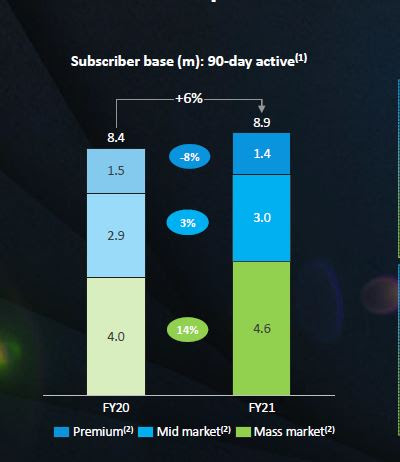
MultiChoice released its latest financial report for the year ending 31 March 2021 that indicates that although its overall pay-TV subscriber base grew thanks to an increase in its mass-market segment, its top-end customer segment in South Africa saw further erosion from 1.5 million to 1.4 million DStv subscribers - representing an 8% decrease.

MultiChoice's mid-market, comprising DStv Compact and DStv Commercial bouquets, grew by 3% from 2.9 to 3 million subscribers. 

The biggest growth came in the so-called mass-market bracket: DStv Family, DStv, Access and DStv EasyView bouquets.

This subscriber segment increased by 14% and roughly 600 000 subscribers in South Africa from 4 million to 4.6 million subscribers. 

MultiChoice now has 20.9 million active subscribers of which 8.93 million (43%) are in South Africa - that remains the pay-TV operator's country with the largest subscriber base - and with 11.93 million (57%) combined in the rest of Africa (RoA).


ARPU: Top end DStv subscriber revenue keeps falling
While MultiChoice is earning more revenue due to the ongoing growth of its overall DStv and GOtv subscriber base, MultiChoice continues to see a slide in what it makes per individual premium subscriber.

A breakout of MultiChoice's ARPU, or "average revenue per user" from within its latest financial report indicates that the ARPU of its premium subscriber segment taken over the past year shrank further from the 18% that it represented in the 2020 financial year, to 16% in the 2021 financial year.


ARPU from DStv Compact subscribers also slightly decreased from 34% to 33%. For the first time, ARPU from MultiChoice's combined mass-market segment represents more than half of the total - up from 48% in 2020 to 51% in the reported financial year.

Taking the DStv money shot from the point of average monthly subscription fee revenue, the ARPU derived from premium DStv subscribers fell further from R588 per month to R580 - a 1% decrease. The monthly DStv Compact ARPU increased by R3 from R298 to R301 - an increase of 1%.

The monthly ARPU of MultiChoice's mass-market subscribers grew from R88 per month to R95 - an increase of 9%.


Top-channels ratings pressure
Although not mentioned in MultiChoice's financial report, the 8% loss of top-end DStv subscribers translates to yet another 100 000 South African TV households who gave up access to premium TV channels ranging from M-Net and kykNET, to SuperSport Grandstand, Discovery Channel and others.

It means that these exclusively packaged channels are coming under ongoing and increasing TV ratings pressure.

These premium-positioned channels are losing viewers and ratings share - and at a much faster rate with their premium content offering that also costs more to produce - than what lower-tiered TV channels are gaining viewers with content that are not just cheaper to make but that's also the premium content that's later cycled down and scheduled across lower packages.

There is an in-built irony here in that the ratings share erosion of the top-end channels on MultiChoice's offering doesn't yet matter so much because of two still-valid-for-now reasons. 

Firstly, as a pay-TV operator, MultiChoice is less dependent on and less worried about ratings (and the ad income tied to those ratings) since its main source of income is derived from monthly subscriber fees that are paid irrespective of whether an individual watches or whether the TV and decoder is never switched on in a month. 

Secondly, DStv Media Sales spot pricing for TV commercials (can) remain stable and even increase despite decreases in audience share, since ironically the dwindling top-end audience makes reaching them even more important and desirable to certain advertisers.

To reach that extremely valuable, high-spending consumer segment - although it's a DStv viewer group getting smaller - advertisers are actually willing to spend the same, if not more, in highly-targeted ad campaigns to reach them with their commercial messages.
  

Monday, December 3, 2018

While DStv subscribers are paying more, MultiChoice is actually making less and less per individual customer and here's why - an ongoing drop in its most valuable p(l)ayers: the DStv Premium subscriber.


While DStv subscribers constantly see their subscription fees increase with another likely DStv price hike set for April 2019, MultiChoice is actually making less and less revenue per individual DStv subscriber - in fact it's back at 2014-levels it last saw four years ago.

Here's why: The cause is the shrinking portion of MultiChoice's "most valuable p(l)ayer": the DStv Premium subscriber who no longer see MultiChoice's top-tier as offering enough value for the monthly money.

On Friday Naspers released its interim results for the 6 months to 30 September 2018 that revealed that MultiChoice had added another 400 000 further DStv and GOtv subscribers as well as Showmax users to its pay-TV business in South Africa and Africa compared to a year before.

That's great, although the portion of DStv Premium subscribers as part of the overall DStv subscriber base continues to shrink.

It means that more and more DStv subscribers don't want to pay to have DStv Premium - it's too expensive for what MultiChoice is offering compared to DStv Compact Plus and DStv Compact and not offering enough value in return for what it costs to have it.

While MultiChoice Group CEO Calvo Mawela earlier this year blamed the drop-off in the share of DStv Premium subscribers on Netflix's aggressive expansion in South Africa and Africa, Naspers on Friday said that the pressure leading to DStv Premium subscriber churn is due to consumers coming "under some disposable income pressure" and not because of competition from video streaming competitors like Netflix.

What the drop in the overall percentage of DStv Premium subscriber numbers means is that MultiChoice is making less average revenue per subscriber.

The term for this is ARPU, or average revenue per user. For the 6 months to 30 September 2018 MultiChoice's ARPU fell 3% from $27 (R347) a year ago to $25 (R335) currently.

As a sidenote, the ARPU as DStv subscription fee revenue includes the PVR Access fee and DStv BoxOffice income, but excludes Showmax subscription fees.

Naspers said that at MultiChoice South Africa going forward "the focus of the South African business remains retaining premium subscribers while driving subscriber growth in the mid- and mass-market tiers" and that "subscriber retention is underpinned by rising PVR penetration uptake of connected video services, and roll-out of additional services".

Now let's look at the DStv ARPU of R335 for the 6 months to 30 September 2018.

It is back at a level last seen in 2014, when the DStv ARPU was also R335.

MultiChoice's DStv ARPU across its African pay-TV business was R335 for its financial year that ended 31 March 2014, R349 for end-March 2015, R347 for end-March 2016, R353 for end-March 2018, and R344 for end-March 2018.

It means that while MultiChoice has more pay-TV subscribers than ever before - 13.9 million in total of which 7.2 million are in South Africa that remains MultiChoice's biggest market, and a combined 6.69 million in the rest of Africa - on an individual basis they are less "valuable" than before.

Think of an airline. While an airplane has first, business, premium economy and economy seats, or mostly business and economy seats, airlines make more money from first and business class passengers - although they're fewer and the number of seats in those cabins are less - than the rows and rows of cheaper paying economy class passengers.

With the MultiChoice Group planning to list on the JSE during the first half of 2019, MultiChoice is going to have to work harder to grow and retain DStv Premium subscribers.

MultiChoice will have to do more to give DStv Premium subscribers more added value and making these pay-TV consumers feel as if it's worth it to pay for the top-tier, like getting a dedicated monthly TV guide magazine, possible exclusive offers, and more bells and whistles like Showmax that used to only be accessible for DStv Premium customers.