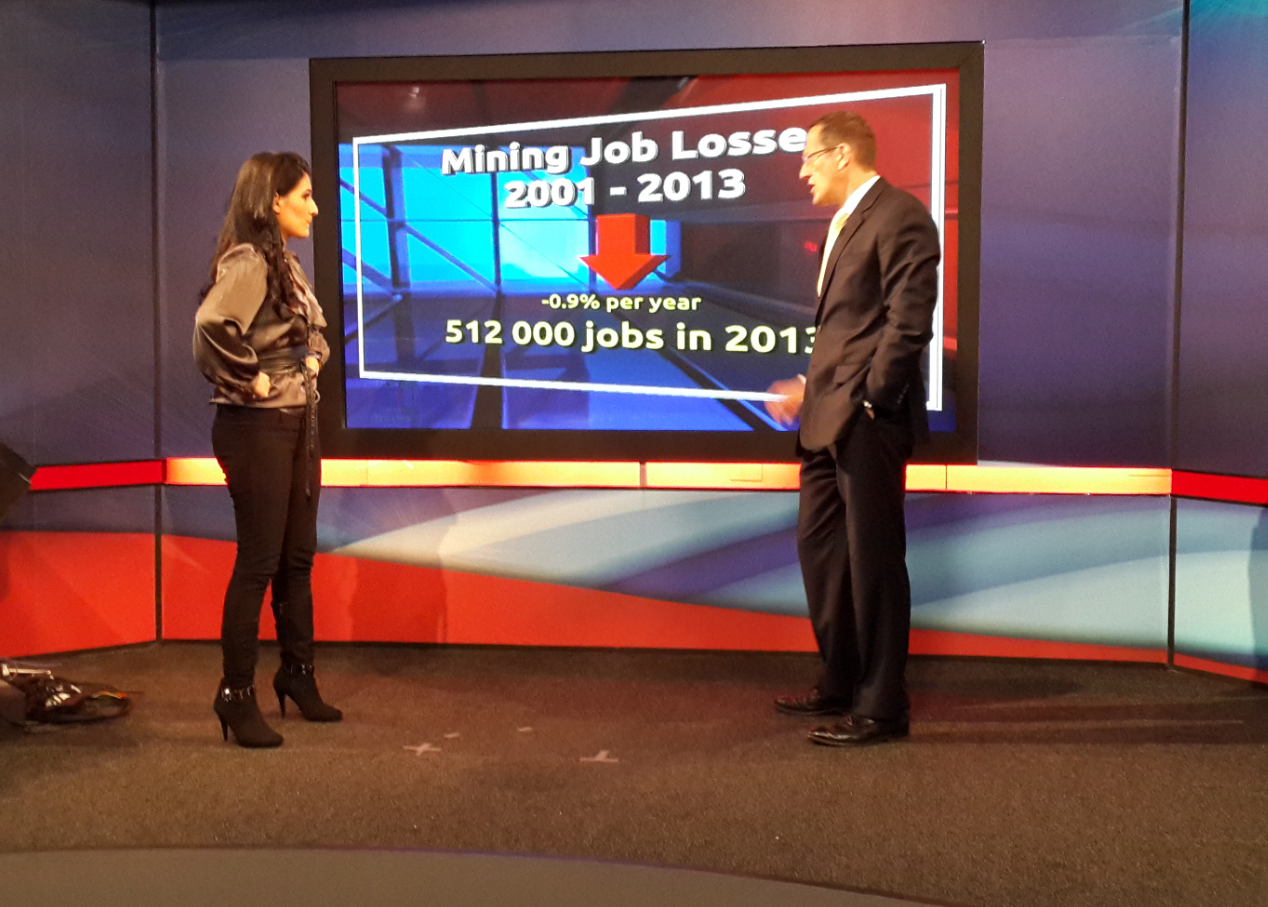
Eleni Giokos, the eNCA (DStv 403) news anchor is back in South Africa after her recent
globe-trotting stint to Switzerland to cover for the 24-hour news channel the World Economic Forum (WEF) this year in Davos.
Eleni Giokos' live coverage and inserts definitely raised the profile of the eNCA, once again bringing viewers in South Africa something brand-new in terms of insightful business coverage and analysis directly from Davos on the channel, from one of the biggest business stages in the world's global economic politik.
With her outstanding television coverage,
Eleni Giokos' was also extremely clever - maximising her visibility to WEF delegates as well as building recognition under viewers - by draping her South African scarf in the country's colours every day around her shoulders. It not only made for dramatic, eye-popping and brilliant brand reinforcement of her and South Africa, but also as a reporter for the eNCA.
I asked
Eleni Giokos about her trend-setting trip, highlights, coverage challenges production-wise behind-the scenes and what it takes to get a seat at the table so to speak as a media outlet and TV reporter.
Eleni Giokos shares remarkable insights - from whom she met, how she thinks South African media is doing with big event coverage, not wasting a moment - and falling on wet ice!
What was your personal and professional highlight of the Davos visit?
Eleni Giokos: Simply attending in itself was a highlight for me; I have wanted to cover
the WEF since I started my career in financial journalism.
My team and I
arrived in Davos with great ambitions to cover all sides of the Forum, to give
our viewers a picture of the conference, deliver hard-hitting interviews, and
also show the lighter side of what is an extraordinary event. We worked
extremely hard to achieve those targets, and I think
in the end we actually
delivered more than we had planned, which was hugely satisfying. Highlights are almost too numerous to mention, but meeting
Tony Blair,
Gordon Brown, and
Nuriel Roubini certainly reckon among them.
Despite what must have been an incredibly busy schedule, CNN International's
Richard Quest
and
John Defterios made time for us, and we also managed to get to know some of
the really helpful and friendly CNN crew working there.
A wonderful
moment was the chance to watch
Quest Means Business broadcast live from
Davos.
I was invited up to CNN's live location to see the show go out,
and it was a fascinating experience to watch one of my favourite anchors at
work. In fact meeting other journalists was a big feature of reporting from the
WEF. I bumped into many reporters and anchors from around the world, many
of whom were extremely keen to talk to me about Africa.
A personal high point was interviewing
Jacob Zuma, as well as a number of SA
ministers. All of them were very upbeat about Africa's prospects, and all
sported SA scarves. But actually it's very hard to pinpoint one specific event, as every day was
special in its own way. It was certainly physically demanding – from climbing
up a mountain on the first day, getting caught in a snow storm and falling on
wet ice, to moving heavy equipment around constantly.
We seemed to be
forever trying to prepare for interviews, which came thick and fast, and
looking out for relevant stories, while negotiating tight security and going
from the warmth of the hallways to the bitter cold outside.
What was difficult or challenging to accomplish regarding this specific
eNCA?
Eleni Giokos: The biggest challenge is in the preparation, knowing what your agenda
will be at the Forum and making sure you follow through on your angle.
Arriving
in a new place is in itself challenging, having to find a way to get from the
airport to Davos, changing trains with equipment and luggage almost impossible
for three people to carry around. And that's not even the important part.
Once
you arrive in Davos the hard work starts and
the truth is you have to have the
confidence to talk, ask, beg and even demand in some cases to get what you
want.
Davos is not a place for the shy - once you see someone you recognise you cannot waste that moment. Exchanging business cards is a part of Davos
culture so you have to be well equipped.
The secret is also knowing how
to sell your brand, once you do this you'll find the dynamics change with the
people around you. I'm sure I embarrassed my team a few times running after
potential guests while calling out their names.
Anything interesting people you ran into or saw or things you saw which
didn’t make it to screen as a story or an interview but which was amazing to
you?
Eleni Giokos: Apart from meeting African and South African, a
person from The Associated Press recognised me – it seems we have more
than just a few loyal eNCA viewers in the UK!
It was great to hear that
we have a following in Britain, and we enjoyed an illuminating conversation.
One thing I loved was the impact my SA scarf made on delegates.
I lost
count of the number of people who asked me where they could get one. Also,
because the South African delegates were all sporting them,
it made
our quarry easy to spot – and a glimpse of SA colours was enough to get us
running after a few potential interviewees.
It was the same clever
marketing strategy adopted prior to the World Cup, and it was clearly still
alive and kicking in Davos. I was also intrigued by the numbers of locals who
had either visited South Africa, lived in South Africa, or planned to visit very soon.
It was
almost uncanny; from coffee shop owners to the man who sold us a euro plug - so
many people seemed to have some kind of link to SA.
The best way to get around Davos quickly was via one of the many official
WEF shuttles, and I quickly discovered that these were also a great place to
network. We found ourselves sharing space with, among others, a Nobel
laureate, a group of ministers from Peru, and some gregarious high-flying
businessmen from Russia.
Of course, I have to say that
it was very, very cold. Nothing prepares you
for minus 15 degrees Celsius in the Alps; you simply cannot buy clothes in South Africa and think they will pull you through a chilly January in Switzerland. If a
company here says "buy this it's made from technical material for up
to minus 10" buy two of everything! Unless they've been to the Alps don't
believe what they say!
Apart from the cold, it was also eye-wateringly expensive: a simple meal
cost me at least R200 to R300. To economise we shopped at the local Euro
Spar, where a packet of crisps cost R50, four tomatoes about R30 and coffee
R80. Chocolate and Swiss Army Knives were pretty much the only two items I can
say were cheaper there than in SA.
How easy or difficult was it for eNCA to “get a place at the table” at Davos for the first time?
Eleni Giokos: As the planning and booking of guests evolved prior to the forum, it was
fascinating to see which delegates were keen to speak with us.
The
vast
majority were very eager to expose themselves to African audiences, which I
think is testament to the growing strength of the continent on the global
stage.
So many businesses and organisations are now looking to tap into the African
market, and it was evident that the chance to get their messages across via
local African media was an opportunity many delegates were keen to grasp.
Africa was such a hot topic, and coverage by African media is also clearly
increasing; I certainly think we made our mark within that environment.
This was our first year covering WEF on the ground (as
Richard Quest told
us, we were Davos Virgins!), but the feedback we've had has been
extremely positive. We have been invited to attend WEF Africa
in Cape Town in May, which I'm sure will attract global names once
again.
In terms of media access, how much work went into trying to get
accreditation and then access to places and people?
Eleni Giokos: I had been speaking with the WEF for quite a while before we received our
accreditation. There is strict protocol regarding media and all profiles are carefully
reviewed. Media coverage and attendance is growing rapidly, and there is
limited space at the WEF - over 1 500 journalists, producers and so on attended
this year, so competition to attend was pretty fierce.
Naturally preference is given to those that have been covering the event for
years. But
once you're in and do a good job, I'm told it gets easier.
With regards to access, we tried to make the right contacts early on. When
we arrived I decided to visit one of most prestigious hotels in Davos, The
Seehof, knowing we would be conducting a lot of our high profile interviews
there.
We met the Hotel Manager and spent an hour or so with him. This
helped enormously on the days we needed to enter the hotel.
Above all though,
you need your accreditation badge with you at all times. Without it you
simply cannot do anything around the congress centre.
One Hotel where we
couldn't access was the Garden Inn. We were scheduled to interview
Tito
Mboweni there and security would not allow us onto the premises. Luckily Mr
Mboweni caught my eye and called his name.
I booked all my interviews before leaving South Africa and I was careful to ensure
that I made contact with as many companies, politicians, and analysts as
possible before we travelled. If you took a look at my inbox I'm
sure you would laugh, as I’m talking about literally hundreds of emails.
Requesting interviews and hearing that hoped for "yes" is one step, but
agreeing on a time and a venue is also tough – it normally happens very close
to the event, which means you're often on tenterhooks until the last minute,
counting on a combination of luck and good time management to see you through.
The WEF does give you contact details of the delegates who will be
attending, but this only happens a week before the event, which just isn't
enough time to make contact and book time with all the attendees whom you'd
like to meet. Interestingly, I found politicians tended to be more
flexible than CEOs. I guess they're a little more keen to be seen and
heard!
Overseas 24-hour news channels are well-versed with these kinds of global
events, but South Africa and TV channels here are still learning, not so?
Eleni Giokos: Some media have been covering the WEF for over 30 years. You simply cannot
compare a team of three to a team of 50, and you only need to look at the
colours of their badges (anchors from the major broadcasters tended to have the
prestigious white "participant" badges, while we had to make do with lesser
yellow ones) to see who has earned their stripes.
Put simply, the more often
you attend, the more people your organization can send, and this dictates what
you can realistically achieve at Davos.
Pre-recorded interviews, live crossings
and packages all need to be planned well in advance. Some media broadcast
entire shows from Davos, which require both enormous technical resources and a
hefty budget.
In contrast,
we were a team of just three; but we still managed to deliver
six live crossings, about 20 pre-recorded interviews, and 6 packages, over 5
days – not bad going I'd say.
One thing that is really noticeable is what a good job South African and African media
are doing covering big events now.
We've earned our stripes recently,
with COP 17, the World Cup, the Olympics and so on. I think African media
and audiences are now more engaged with the world, and want to draw their own
conclusions rather than rely solely on the big networks to deliver
international stories to them.
We are sending journalists to offer
Africans something a little different – something geared towards their specific
interests and outlook. This is a hugely encouraging development; we should be
proud that we're delivering our audiences access to a global event from a
genuinely African perspective.